
A study of John 1:3–5
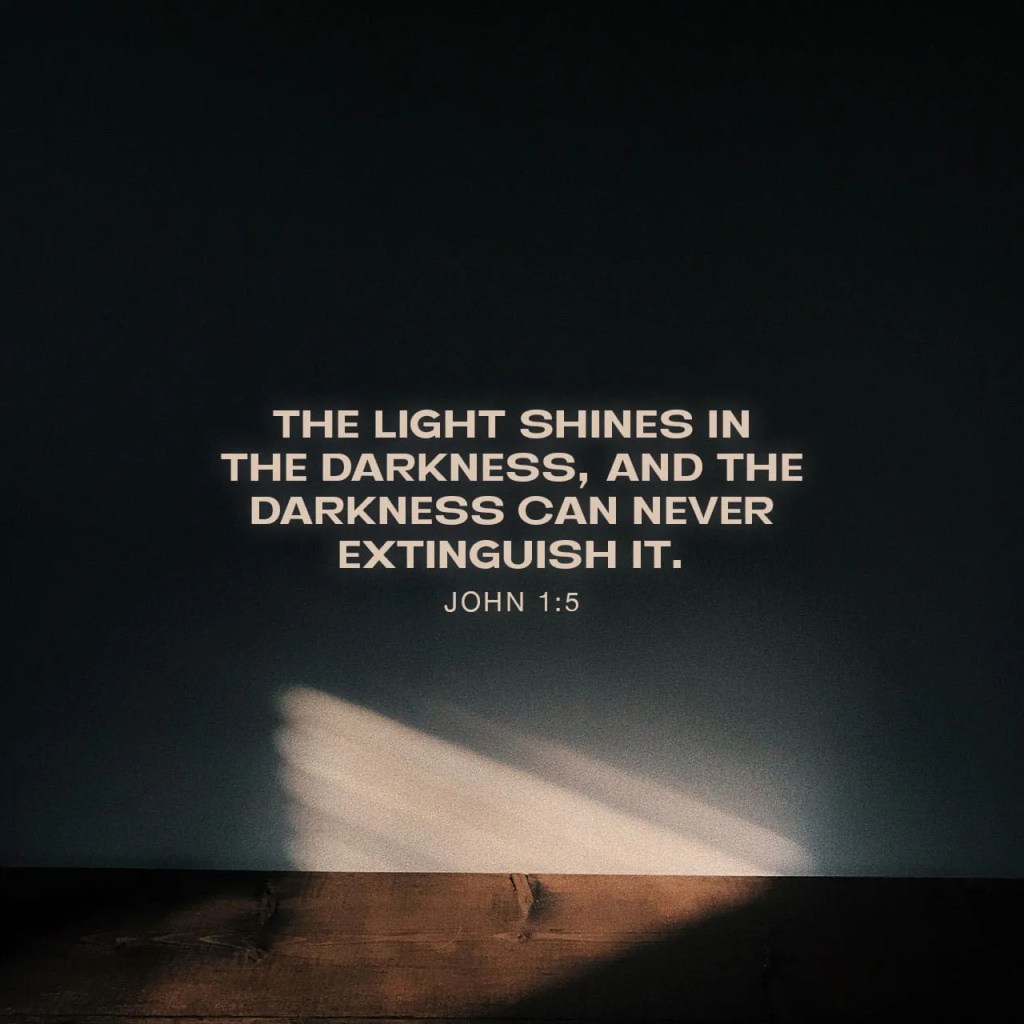
“All things were made through him, and without him was not any thing made that was made. In him was life, and the life was the light of men. The light shines in the darkness, and the darkness has not overcome it.”
John 1:3-5
Definitions of the original language in the context of this passage:
-All Things: “pas”, “πᾶς”; adjective — in an absolute sense, all things that exist, all created things.
-Were Made: “ginomai”, “γίνομαι”; verb — to become, i. e. to come into existence, begin to be, receive being.
-Life: “zōē”, “ζωή”; feminine noun — of the absolute fullness of life, both essential and ethical, which belongs to God, and through him both to the hypostatic λόγος (logos) and to Christ in whom the λόγος (logos) put on human nature: in him life was (comprehended), and the life (transfused from the Logos into created natures) was the light (i. e. the intelligence) of men (because the life of men is self-conscious, and thus a fountain of intelligence springs up).
-Light: “phōs”, “φῶς”; neuter noun — φῶς is used to denote truth and its knowledge, together with the spiritual purity congruous with it, i.e. became the source of human wisdom (John 1:4); especially the saving truth embodied in Christ and by his love and effort imparted to mankind (John 1:5)
-Darkness: “skotia”, “σκοτία”; feminine noun — metaphorically, used of ignorance of divine things, and its associated wickedness, and the resultant misery.
-Overcome (Comprehend): “katalambanō”, “καταλαμβάνω”; verb — to make one’s own, to take into oneself, appropriate.
Observation/Summary (short explanation of what the passage says in your own words):
Following verses 1–2 where John told us of this “Word” who was with and always has been God from eternity past and the beginning of creation, we now read all things were made through Him. To make it abundantly clear “all” things were made through Him, John also says, “and without Him was not anything made that was made.” In addition to creating all matter, life was also in Him, and this life is the light of men. This light shines in the darkness, and the darkness has not overcome it.
Implication (what does this mean to us):
This “Word” or “Logos” in the original Greek John speaks of is Jesus Christ. The reason he opens by calling Him the “Word” is because he is speaking to a concept both Jewish rabbis and Greek philosophers had discussed for a long time. The Jews referred to God as “The Word of God,” and Greek philosophers referred to the force or being that created the universe as “The Word” or “Logos”. By use of the word “Logos” it would have been clear to John’s contemporaries that he was writing of the originator of all creation which both the Jews and the Greco-Romans had spent centuries discussing the nature and identity of. As we read further in this gospel it will become abundantly clear John is writing to say that Jesus Christ is the “Logos” or “Word” of whom they have sought knowledge of for so long.
In verse 3 of John 1, John tells us the Word, who is Jesus, made or created everything that exists, and without Him nothing that has been brought into existence could have been brought into existence. In saying this John is proclaiming Jesus to be an uncreated being who has no beginning. He is linking Jesus to passages like Genesis 1:1 where we read God created the heavens and the earth. Also he is drawing the mind of his Jewish and God-fearing Greek hearers to passages such as Psalm 33:6 which says, “By the word of the Lord the heavens were made, and by the breath of his mouth all their hosts.” These Old Testament passages say God created all things, and now John is saying Jesus Christ created all things. He does this to inform us that Jesus Christ, God the Son, is one with God the Father. He has existed from before the beginning, and He created and sustains all things that are in existence.
Paul echoes these words in passages such as 1 Corinthians 8:6 which says, “yet for us there is one God, the Father, from whom are all things and for whom we exist, and one Lord, Jesus Christ, through whom are all things, and through whom we exist.”, and the author of Hebrews writes, in Heb 1:2, “but in these last days he has spoken to us by his Son, whom he appointed the heir of all things, through whom also he created the world.” From this we learn Jesus Christ is God Himself, One with the Father, who has existed from eternity past and has created all things.
In verse 4 we read in “him”, that is, in Jesus Christ, was life and this life was the light of men. “Life” is translated from the Ancient Greek word “zōē” and this describes more than simply biological life or “bios” as it is called in Ancient Greek. This describes the principle of life which includes the physical, moral and eternal life. All that life was and is, is contained in Him, the “Logos”. He is the source of life and all that it encompasses, and it is by His power that all life is sustained. As Jesus said in John 5:26, “For as the Father has life in himself, so he has granted the Son also to have life in himself.”, and also in John 14:6, “Jesus said to him, ‘I am the way, and the truth, and the life. No one comes to the Father except through me.’.”
Next, we read the life was “the light of men.” In breathing life into mankind He has created us with immortal souls capable of comprehending moral good and intellectual concepts in a way no other created being in this world can. We are not the same as the many wonderful and fascinating animals He has created. We are undeniably different. He made us as a reflection of His divine nature, made us creative and inventive; and He has enlightened our minds to understand good and evil, as well as implanted a desire in our hearts for what is good and pure. It is not simply that Jesus, the Word, has life and light within Himself, rather, He is life and light. He is the one and only source of life and light.
Having been created by Jesus who is life and light, mankind has a natural fear of death and darkness, and without Jesus we are dead, lost and imprisoned in darkness. This is what Jesus came to deliver us from as was prophesied in Isaiah 42:16, “And I will lead the blind in a way that they do not know, in paths that they have not known I will guide them. I will turn the darkness before them into light, the rough places into level ground. These are the things I do, and I do not forsake them.” Also, in Malachi 4:2 the Lord says, “But for you who fear my name, the sun of righteousness shall rise with healing in its wings. You shall go out leaping like calves from the stall.” Jesus, who is life and light, has breathed life into mankind and enlightened mankind with an implanted knowledge of the Divine and His moral law (Romans 1:19–32). Human beings are radically different from any beast of the field, fish in the sea or bird in the air. We are image bearers of the Ancient of Days, and His life and light are in us.
Lastly, we read “The light shines in the darkness and the darkness has not overcome it.” While light is used to describe truth, wisdom and knowledge of good and evil in verse 4, the definition is here expanded to include the saving truth which Christ embodied and gave to mankind through His loving sacrifice. The darkness is used metaphorically to describe ignorance of the things of God, evil that accompanies such ignorance and the misery and suffering that comes of it. In the beginning Jesus breathed life into mankind, but ever since the fall of man into sin, darkness has enveloped His creation, but even so, the darkness has not overcome the light.
“Overcome” can also be translated as “comprehended” from the Ancient Greek word “katalambanō”. There is some debate over the translation of this word, but in this context it seems reasonable to conclude that at the very least it means to “make one’s own, take into oneself, appropriate.” From this we learn, the darkness has not been able to overcome the light, make it its own or (mis)appropriate it, because the light will never be overcome by the darkness. Jesus proved this by descending into the darkness of this world under the curse of sin as the Light of the world. He defeated sin and death, rose again from the grave as proof, and His light shines today just as it has for eternity past and will continue into eternity future.
Application (How does this change how I think, act and pray?):
This passage should cause us to think of Jesus as Almighty God who created all things, and is the life and light of all mankind. Although we are born into the darkness of sin, His light still shines and the darkness has not overcome it. Knowing this should give us confidence even as we see and experience the darkness and resultant suffering in this world that good will triumph in the end because the darkness will never overcome the light. This should cause us to live a life of active service to Christ where we shine His light on others by loving them and caring for them.
We should also pray for God to illuminate the hearts and minds of the unsaved people around us with His light, and pray about how we can best cooperate with Him in doing that. Most of all, this passage should give us the confidence that Jesus Christ is fully God and fully man, who created all things, illuminates the hearts and minds of mankind, and that He is the Overcomer who will never be overcome.
Self Reflection:
How does the fact that Jesus Christ created all things affect my view of who He is?
How does the fact that Jesus is life and light, and is the one and only source of life and light in the universe affect my response to Him and His Words I read elsewhere in the Bible?
How does this knowledge of the nature of Christ affect my daily life and response to the darkness in this world?
 Home
Home 
Leave a comment