
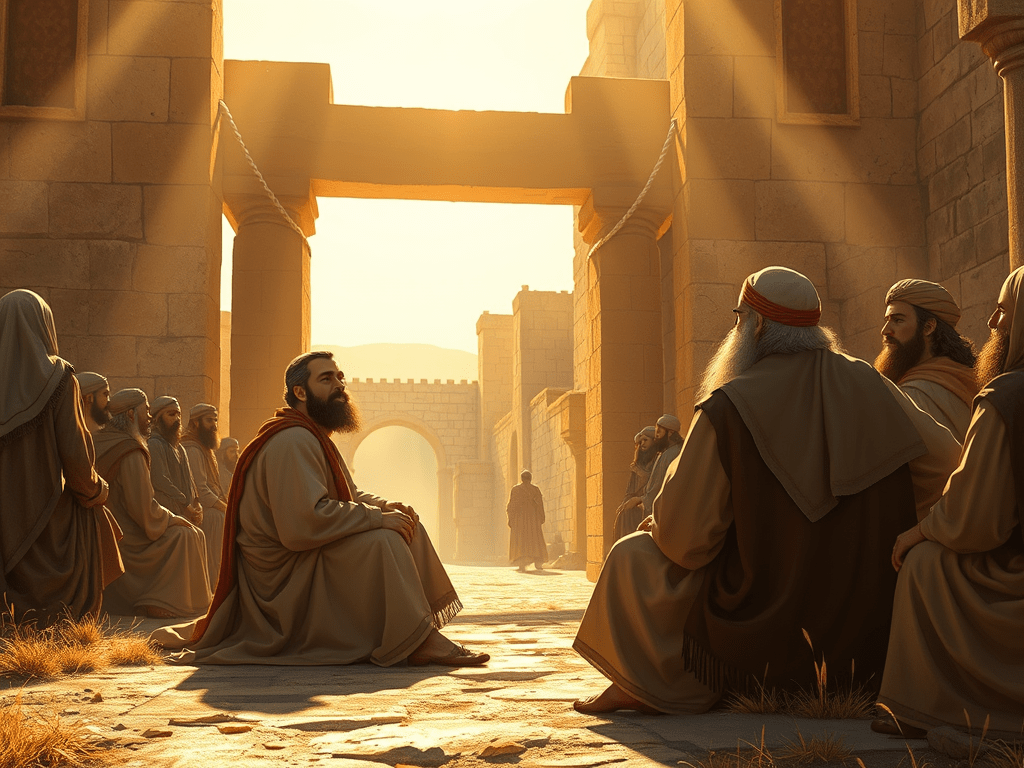
A Study of Ruth 4:1-6
“Now Boaz had gone up to the gate and sat down there. And behold, the redeemer, of whom Boaz had spoken, came by. So Boaz said, “Turn aside, friend; sit down here.” And he turned aside and sat down. And he took ten men of the elders of the city and said, “Sit down here.” So they sat down. Then he said to the redeemer, “Naomi, who has come back from the country of Moab, is selling the parcel of land that belonged to our relative Elimelech. So I thought I would tell you of it and say, ‘Buy it in the presence of those sitting here and in the presence of the elders of my people.’ If you will redeem it, redeem it. But if you will not, tell me, that I may know, for there is no one besides you to redeem it, and I come after you.” And he said, “I will redeem it.” Then Boaz said, “The day you buy the field from the hand of Naomi, you also acquire Ruth the Moabite, the widow of the dead, in order to perpetuate the name of the dead in his inheritance.” Then the redeemer said, “I cannot redeem it for myself, lest I impair my own inheritance. Take my right of redemption yourself, for I cannot redeem it.””
Ruth 4:1–6 ESV
Observation/Summary (short explanation of what the passage says in your own words):
Boaz went to the city gate, sat down, and waited for the redeemer, who was in line before him, to come by. When Boaz saw the man approaching, he invited him to sit with him. When the man agreed, Boaz called over 10 of the elders of the city, who joined them as well. Next, Boaz explained that Naomi, the widow of their close relative Elimelech, who had returned from Moab, held the rights to a piece of land that was eligible to be redeemed, or bought back into the family. So, Boaz went on to tell this man, who was the closest relative to Elimelech ahead of Boaz, that he had the first right of refusal. If this man wanted to redeem, or buy back, the land, he was welcome to do so. But if he did not want to redeem the land, Boaz would, because he was the next closest relation of Elimelech.
The redeemer said he would buy the land, but then Boaz revealed that whoever bought the land must also marry Ruth, the widow of Elimelech’s deceased son. The redeemer then said he could not redeem the land and take Ruth as his wife because it would “impair” his own inheritance. And in saying this, he also willingly relinquished his role as redeemer, and the right and role of redeemer passed to Boaz.
Implication (what does this mean to us):
Here begins the final chapter of the short and profound book of Ruth. At the end of chapter 3, the scene was set for this climatic encounter at the city gate. Prior to this, we read of the Israelite man Elimelech who took his wife Naomi and their two sons from Bethlehem to Moab to escape famine. While in Moab, Elimelech died, his two sons married Moabite wives, Ruth and Orpah, and then they died as well, leaving Naomi, Ruth and Orpah as childless widows. Childless widows were among the most vulnerable and impoverished people on the socio-economic ladder in this time and place, and these ladies were left in a dire situation.
As Naomi found herself widowed and childless, she heard the famine in Israel had ended, so she decided to go back to Bethlehem where she could scrounge for a living among her own people. As she set out to leave, she urged Ruth and Orpah to return to their Moabite families where they would be cared for and enabled to find new husbands. They would have had little hope of doing so as foreigners in Israel. In urging them to leave her, Naomi also told them to return to their “gods”.
After much tearful back and forth discussion, Orpah decided to return to her family in Moab, but Ruth refused. Naomi then told Ruth to leave one last time, and in her bitterness and grief she told Ruth to return to her “people” and her “gods” because Naomi’s God, Yahweh, had brought this calamity on her. Naomi was correct that Yahweh is in control, but she was incorrect in saying Yahweh was against her. In spite of this, Ruth refused to leave Naomi again, declared she would live and die with Naomi, and that Naomi’s God, Yahweh the one true God, would be her God too.
So, an understandably embittered and grieving Naomi returned to Bethlehem with Ruth by her side. When they got there Ruth went to work gleaning grain in the fields to provide for herself and Naomi. As she did this the people of the city noticed Ruth’s admirable character and selfless, loving loyalty to Naomi in choosing to stay with her, even though it would likely mean a life of desperate poverty. As Ruth worked diligently to glean grain, a wealthy and honorable landowner named Boaz took notice of her exemplary character and saw to it that she was provided for and showed her much kindness. As Ruth told Naomi about him, Naomi pointed out that Boaz was a close relative of Naomi’s deceased husband, Elimelech, and as such Boaz could fulfill the role of “Goel” or “Kinsmans-Redeemer” by marrying Ruth, producing an heir to perpetuate the family name of Elimelech, and by buying back the family land; thus providing for Ruth and Naomi, and rescuing them from near complete destitution.
In chapter 3, Ruth made her desire to marry Boaz known in a bold, but not inappropriate way for that culture, and Boaz happily agreed. Being an honest man though, he told Ruth there was one man closer in relation to Elimelech than him, and that this man had the first right of redemption before him.
It is important to note that in ancient Israel, under the law given to the people by Yahweh, there was a legally defined role known as the “Goel” or “Kinsman Redeemer.” The redeemer, if able, was called upon to marry his relatives’ childless widow when the husband died. This was a compassionate legal system that provided for widows and perpetuated the family name of the widow’s deceased husband via an heir produced by the redeemer and widow in marriage. In addition to this, the redeemer was also obligated and legally permitted to buy back family land that had been relinquished due to debt and also to ensure justice was done in the event of a family member’s death. In this situation with Ruth, Naomi was too old to remarry and have children, but Ruth was still young. So, because Ruth was still of marriageable age, to redeem Elimelech’s family land the redeemer would also have to marry Ruth, the widow of Elimelech and Naomi’s son.
While Boaz certainly wanted to marry Ruth, and accepted her daring and dramatic proposal, because Boaz was also an honorable man, he did the right thing in first presenting the man who was closer in relation to Elimelech than him with the opportunity to be a redeemer to Ruth and Naomi. So, at the beginning of chapter 4, we find Boaz, the morning after Ruth proposed to him, immediately going to the city gate to, as Naomi assured Ruth he would do, “settle the matter today” (Ruth 3:17).
In verse 1 of this passage we read Boaz did just that. No doubt elated and in love, Boaz went to settle the matter the very next day, and to do so he went to “the gate.” The city gate was an important location in ancient cities, and Bethlehem was no different. The city gate was where one could find the marketplace (2 Kings 7:1), prophets and teachers speaking (1 Kings 22:10), or even legal rulings taking place in the presence of city elders or kings (Deut. 21:19; 22:15; 2 Sam. 15:2). This was the place where business was conducted, and where the elders or leaders of the city met to resolve matters brought to them. In this case Boaz came to the city gate to resolve the matter of who would take up the role of Goel or Redeemer for Elimelech’s family. For this reason Boaz went there first thing in the morning, and when he saw the redeemer he said to him, “Turn aside, friend; sit down here.” and the man sat down.
Interestingly, the Hebrew word translated as “friend” in Boaz’s address to the nearer relative could be translated as “so-and-so.” The man’s name is never mentioned in this written account, likely because the author of Ruth did not want to show honor to the man who refused to do his duty as kinsman-redeemer because of the financial cost to himself. He was willing to watch the widows of his near relatives suffer extreme poverty rather than expend his own wealth and energy to raise them out of poverty. Because of this it is the selflessly generous Boaz whose name we learn instead.
Next, in verse 2, because Boaz was there to settle a legal matter, he asked 10 elders of the people to sit with them and act as witnesses to the transaction and to affirm it was done in accordance with the law (Deuteronomy 25:5-10). These elders would have been respected leaders in their community who the people came to in order to settle matters like this one.
In verses 3-4, in the presence of witnesses, Boaz began to inform the man of the situation saying, “Naomi, who has come back from the country of Moab, is selling the parcel of land that belonged to our relative Elimelech. So I thought I would tell you of it and say, ‘Buy it in the presence of those sitting here and in the presence of the elders of my people.’ If you will redeem it, redeem it. But if you will not, tell me, that I may know, for there is no one besides you to redeem it, and I come after you.” “And he said, “I will redeem it.”.”
In Boaz’s initial explanation of the situation He only mentioned the land that was available, but He did not mention the obligation to marry Ruth that went along with the land. A kinsman redeemer was responsible for buying back family land, but also to marry the childless widow of the deceased relative who previously held the land. Upon hearing first of the land only, the man readily agreed. If fulfilling his responsibility was sure to enrich himself and his immediate family with more land, he was all too happy to buy back the land.
If Ruth and Naomi were present to witness these proceedings, and they might have been, the man’s desire to redeem the land likely would have caused them to quietly dismay. But Boaz had a plan, and in verse 5 Boaz told the man who appeared eager to play the part of honorable redeemer that to do so would also cost him something; he must marry the widow Ruth as well, and produce an heir and inheritance for the line of Elimelech through their marital union. So, to redeem the land of the dead relative, the redeemer must also marry the widow of the dead relative’s progeny. And in so doing he would need to invest money to buy and care for the land which would eventually pass on to the child heir of Elimelech born by Ruth and not to his own children of his own immediate family name.
As we read in verse 6, this is not something the man was willing to do. He rescinded his initial consent to buy the land when he heard about the widow Ruth by saying, “I cannot redeem it for myself, lest I impair my own inheritance. Take my right of redemption yourself, for I cannot redeem it.” To redeem the land allotted to the deceased husband of the widow Naomi would have taken investment to both buy back the land and work the land. Initially this seemed like a good investment, but once Boaz reminded the man of the widow Ruth (Naomi was too old to remarry and have children), he was no longer willing to redeem because to redeem the widows and land of his relative was a cost he was not willing to pay. Overall, it seems a selfish decision, though understandable in a way. The way the man spoke of impairing his own inheritance indicates he was already married and had children; so, to invest in redeeming land that would go to Ruth’s yet to be born male child, was not something He was willing to do.
Perhaps we should not be too harsh on this man, but still, the fact is, being aware of Naomi and Ruth’s desperate situation, as the entire town of Bethlehem was (Ruth 1:19-22; 2:5-6, 11), he refused to redeem the land when he was reminded about Ruth for selfish reasons.
Redemption is costly, and this man would likely not have seen a monetary return on the investment needed to redeem the land and pass it on to a son born of Ruth. And in addition to possibly wanting to avoid tension with his current wife, (unclear, but possible), maybe he wanted to avoid the relational complications associated with bringing home a new wife. But whatever the exact details may have been, seeing Boaz there, ready and willing to redeem, this man took the out and stepped away.
However, as he relinquished his right of redemption, no doubt the hearts of Boaz, Ruth and Naomi soared. Boaz’s shrewd plan in how to present the situation worked, and now the right of redemption fell to Boaz. And, Boaz was able to accomplish this honorably. He presented the situation to the man in broad daylight, in the presence of witnesses, and now could proceed with a clear conscience, rejoicing in Yahweh for His blessing on the situation.
In Boaz’s choice to redeem Ruth and Naomi we see the shadow of the ultimate Redeemer, Jesus Christ; Yahweh incarnate. What did Boaz “get” for redeeming Ruth and Naomi? He got them. It was going to cost Him something to redeem them, and they had nothing to offer Him in return except their trust and loyalty. True, Ruth was seemingly a beautiful woman, but Boaz was a wealthy landowner. Finding a wife would not have been a problem for him. He redeemed Ruth because he clearly loved her, and He was willing to pay the cost to redeem her for the sake of a personal relationship they both expressed a desire to have with one another.
In this picture of selfless redemption we can see the outer fringes of Yahweh’s ways. We have nothing to offer Him except our loyalty and trust; key components in any relationship. And this is all He asks of us. He redeemed us at great cost to Himself; Jesus Christ (Jesus is Yahweh) left the matchless splendor of heaven, to be born as a human, retaining the fullness of His Deity but choosing not to use certain powers to live with us in the dirt and experience the same kinds of pain and grief we experience (Isaiah 53:3-5). And He did this while we were still enemies of His (enemies by our own choice). Boaz at least saw Ruth’s beauty and admirable character in action, but Jesus came to redeem us while we were still at enmity with Him.
Jesus Christ our Redeemer has paid the ultimate redemption price to redeem us from bondage to sin and death by laying down His own life while we still cursed Him and called out for His blood. This is costly redemption. This is love.
“For while we were still weak, at the right time Christ died for the ungodly. For one will scarcely die for a righteous person—though perhaps for a good person one would dare even to die— but God shows his love for us in that while we were still sinners, Christ died for us. Since, therefore, we have now been justified by his blood, much more shall we be saved by him from the wrath of God. For if while we were enemies we were reconciled to God by the death of his Son, much more, now that we are reconciled, shall we be saved by his life. More than that, we also rejoice in God through our Lord Jesus Christ, through whom we have now received reconciliation.”
Romans 5:6-11 ESV
Response (How does this change how I think, act and pray?):
This passage should cause us to consider the meaning and cost of redemption. Redemption means to “buy back.” Our God created us, but we severed our relationship with the True Vine, and now we are slaves of sin, doomed to die apart from some underserved, merciful and costly intervention. Because the wages of sin is death, the cost of our redemption is the death of One who can satisfy the infinite debt we owe to an infinite God for violating His law and rejecting His offer of loving, relationship. Boaz and Ruth were not marrying each other because they wanted more land; they wanted to marry each other because they loved each other. The land just happened to be included in the relationship.
It is just so with God and us. Eternal life, love, joy, peace, growth in righteous living and many other good things are the result of a restored relationship with God by faith in Jesus. We do not desire Him because of these things. We desire Him because He is worthy of our loyal love and trust. In other words, followers of Jesus love and adore the Giver infinitely more than His gifts, because He is infinitely glorious and His excellencies are manifold and varied. The many good gifts He promises and gives in His wise and loving timing, are simply the results of entering into a restored relationship with our loving Creator, Jesus, who delights to give us good gifts, in His wise timing, because He loves and adores us.
Self Reflection:
- What does the cost of redemption that Jesus paid to redeem me tell me about His love for me?
- How does the fact that Jesus willingly suffered in my place, help me to trust Him as I face difficult circumstances I do not understand?
- How might Jesus be calling me to love others in my life, especially when they treat me badly? How does His redemptive work, and His indwelling Spirit give me confidence that loving my enemies is not in vain?
Definitions of the original language in the context of this passage (Source: Logos Exegetical Guide and Blue Letter Bible Interlinear):
-Boaz: “בֹ֨עַז”, “ḇōʹ·ʿǎz”; noun, proper, masculine, singular, absolute – Boaz = “fleetness”; ancestor of David, kinsman-redeemer to Ruth, daughter-in-law of Naomi.
-[The] Gate: “שַּׁעַר֮”, “šǎ·ʿǎrʹ”; noun, common, singular, absolute – gate, gatehouse; gate = space inside gate, as public meeting-place, market (2 Kings 7:1, 18), place of public well (2 Samuel 23:15, 16 = 1 Chronicles 11:17, 18), where elders, judges, king, sat officially (Ruth 4:1).
-Redeemer: “גֹּאֵ֤ל”, “gō·ʾēlʹ”; verb, Qal, participle, masculine, singular, absolute – redeemer, be the next of kin, act as kinsman, do the part of next of kin.
-Friend: “פְּלֹנִ֣י”, “pelō·nîʹ”; noun, common, singular, construct – so and so, a certain unnamed someone.
-Naomi: “נָעֳמִ֔י”, “nǒ·ʿǒmîʹ”; noun, proper, feminine, singular, absolute – Naomi = “my delight”; wife of Elimelech, mother of Mahlon and Chilion, and mother-in-law of Ruth and Orpah.
-Moab: “מוֹאָֽב”, “mô·ʾāḇʹ”; noun, proper, singular, absolute – Moab = “of his father”; a son of Lot by his eldest daughter; the nation descended from the son of Lot; the land inhabited by the descendants of the son of Lot.
-Elimelech: “אֱלִימֶ֑לֶךְ”, “ʾělî·měʹ·lěḵ”; noun, proper, masculine, singular, absolute – Elimelech = “my God is king”; Naomi’s husband.
-Redeem It: “גְּאָ֔ל”, “geʾālʹ”; verb, Qal, imperative, second person, masculine, singular – act as kinsman, do the part of next of kin; a. in taking a kinsman’s widow (Ruth 3:13); b. in redeeming from bondage (Leviticus 25:48, 49); c. in redeeming a field (Leviticus 25:26, 33, Ruth 4:4, 6); d. claim as kinsman (Job 3:5); e. the avenger of blood (Numbers 35:19, 21, 24, 25, 27).
-Ruth: “ר֣וּת”, “rûṯʹ”; noun, proper, feminine, singular, absolute – Ruth = “friendship”; daughter-in-law of Naomi, wife of Boaz, and great-grandmother of David.
-Inheritance: “נַחֲלָתֽ”, “nǎ·ḥǎlāṯʹ”; noun, common, feminine, singular, construct – hereditary property, possession, inheritance, heritage.
-Right of Redemption: “גְּאֻלָּת”, “geʾǔl·lāṯ”; noun, common, feminine, singular, construct – right and obligation of repurchase; repurchase.
 Home
Home 
Leave a comment