
A Study of Ruth 4:7-12
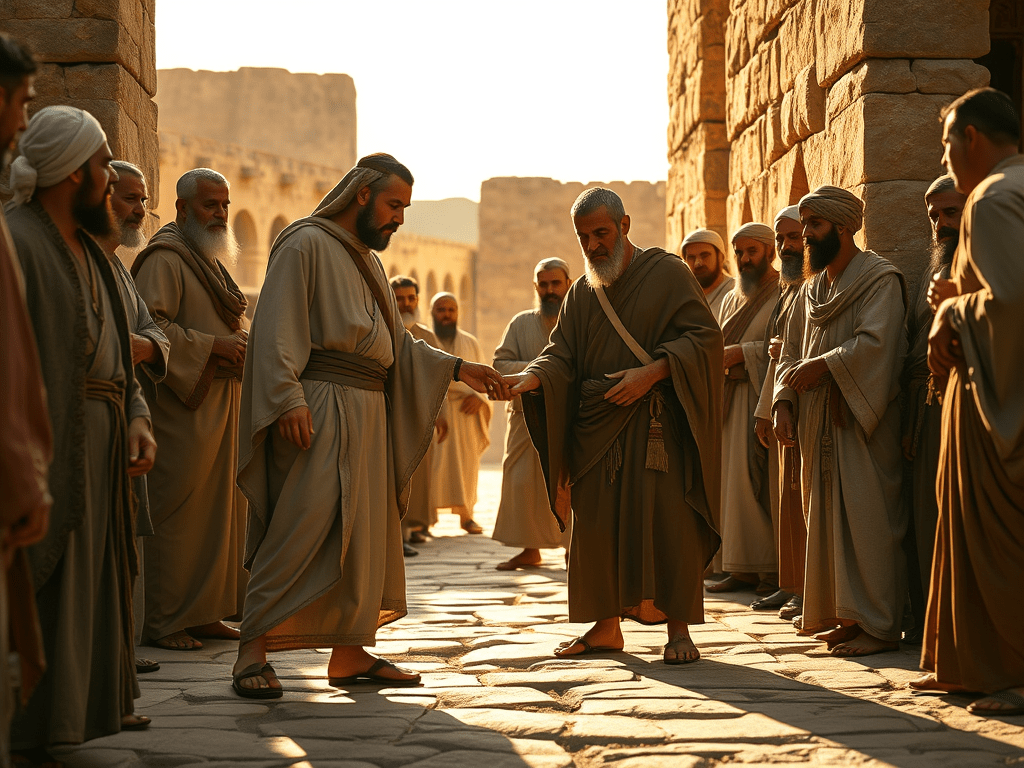
“(Now this was the custom in former times in Israel concerning the kinsman-redemption and transfer of property: to confirm the matter, a man removed his sandal and gave it to his fellow countryman. This was the manner of attesting in Israel.) So the redeemer said to Boaz, “Acquire it for yourself,” and he removed his sandal. And Boaz said to the elders and all of the people, “You are witnesses today that I have acquired all that was for Elimelech and that was for Chilion and Mahlon from the hand of Naomi. And also Ruth the Moabite, the wife of Mahlon, I have acquired as a wife, to raise up the name of the dead over his inheritance, so that the name of the dead may not be cut off from his relatives and from the gate of his birth place. You are witnesses today.” And all of the people who were at the gate and the elders said, “We are witnesses. May Yahweh make the woman coming into your house as Rachel and as Leah, who ⌊together⌋ built the house of Israel. May you have strength in Ephrathah and bestow a name in Bethlehem. And may your house be like the house of Perez, whom Tamar bore to Judah from the offspring that Yahweh will give to you from this young woman.
Ruth 4:7–12 LEB
Observation/Summary (short explanation of what the passage says in your own words):
In ancient Israel, during the time of the Judges, before the establishment of the monarchy, to confirm transactions in regards to kinsman-redemption, property transfer and other similar situations, a man would remove his sandal and give it to the other man in the presence of witnesses. In this case, the man who was closer in relation to Naomi’s deceased husband Elimelech agreed to pass on his right of redemption, in regards to buying back Elimelelch’s family land, and to marry Ruth and produce an heir to perpetuate the name of Elimelech, to Boaz.
After the man did so, Boaz proclaimed to the elders and other witnesses from Bethlehem that he would exercise his rightful claim to buy back the land and marry Ruth the Moabite. All of the people present then confirmed they were witnesses to this transaction, and they also gave a prayerful blessing declaring their desire to see Boaz and Ruth blessed by Yahweh with an abundance of children.
Textual Analysis and Implication (what is being said and what does this mean?):
In the verses previous to these Boaz went to the city gate of Bethlehem, the place where people gathered for various reasons, such as, to hear prophets and teachers, and also to conduct business or legal transactions. In this case Boaz called for the elders of the city to sit with him and the man who had the first right of kinsman-redemption in regards to Ruth’s deceased father-in-law Elimelech. Boaz began by telling the man the land belonging to Naomi’s dead husband Elimelech was available for redemption. In hearing this the man readily agreed to redeem, a.k.a. “buy back”, the land as he saw a good opportunity for a sound investment. But once Boaz told him he must also marry Ruth and produce an heir, the man backed out of the deal because any resources invested in this deal would subtract from his own children’s inheritance.
Kinsman-redemption was a compassionate provision in ancient Israelite law that called for the closest male relative of a married man who died without producing a male heir to marry the dead’s widow and buy back any land lost due to debt in order to produce a male heir to perpetuate the name of the dead, and to care for the widow. This was a kind and compassionate law instituted by the command of Yahweh, because childless widows were among the most vulnerable groups on the socio-economic ladder in this time and place. While Naomi was too old to remarry and produce an heir, Ruth, the widow of Elimelech and Naomi’s dead son, was still young enough to remarry and have children.
While we can understand the man who passed on his right/obligation of redemption most likely already had a family, this was still a selfish move. However, this man’s selfishness resulted in the right of redemption falling to Boaz, who was all too happy to marry Ruth after she expressed her desire to marry him in the previous chapter. In contrast to the unnamed man, Boaz was most interested in having a loving, marital relationship with Ruth, and any land gained in the process, at whatever financial cost, was simply a pleasant, secondary result of the marriage.
In this passage we read of how this transaction took place and of the response of the people who watched as Boaz, the closer male relative, and the elders conducted the transaction appropriately according to the law of the land.
In verses 7-8 we are told the custom in Israel to confirm transactions including but not limited to passing on the right of kinsman-redemption was to remove one’s sandal and give it to the one who was accepting the right of kinsman-redemption. So, the man who was closest in relation to Elimelech agreed to pass on his right of redemption to Boaz, and he removed his sandal and gave it to Boaz in the presence of the city elders and the onlooking people of Bethlehem.
Deuteronomy 25:5-10 details the procedure for this type of transaction. However, it also adds that the one who refuses to marry his brother or close relation’s widow was supposed to remove his sandal, hand it to the widow, and then the widow was to spit in his face, and from then on all the people were to refer to him and his household as, “The house of him who had his sandal pulled off.” So, to refuse to redeem a close relative’s widow (widows were extremely vulnerable to poverty and hardship in this time and place) was rightly seen as selfish and shameful. In this case though, Boaz and those present deemed it sufficient for the man to simply give his sandal to Boaz in the presence of witnesses. No doubt everyone present had their own thoughts about the man, and the fact that we do not know his name tells us his name and household will not be remembered, and instead, it is Boaz and Ruth who are remembered and granted the honor of being a part of the royal, messianic lineage from which the kings of Israel, Judah, and Jesus the Christ and the King of kings, would be born (Matthew 1:1-17).
Next, in verses 9-10, Boaz proclaimed to everyone present that they were witnesses to the fact that he had now legally taken on the role of kinsman-redeemer for Ruth and Naomi, and in so doing he would redeem the land allotted to Elimelech’s family, marry Ruth, and produce and provide for an heir to carry on the family name of Elimelech so that his family name would not be “cut off from the gate of his birthplace.” This was no doubt declared with much joy and jubilation. In the previous chapters it was clearly shown that Boaz admired Ruth’s selfless and noble character as he saw her make the difficult choice to remain with Naomi as a widow in a foreign land to take care of her, and also to renounce her old gods and choose to worship Yahweh the one true God. And, as Ruth asked him to marry her and fulfill the role of kinsman-redeemer in chapter 3, Boaz readily agreed and went to see to the matter the very next morning.
It is important for us to recall that Ruth seemed to be giving up the only chance she would have at a good life back in chapter one when she, in contrast to Orpah, decided to remain with Naomi and go to Bethlehem instead of returning to her family and her gods in Moab. But Ruth put a relationship with Naomi, and more importantly, Yahweh the one true God first. Ruth was willing to give up her most likely prospect of marriage in Moab and a more comfortable life for the sake of pursuing the true and living God. Now, we can see Yahweh rewarding her with more than she could have imagined possible when she made that difficult decision. And it is just so with us who follow Jesus today.
Jesus is Yahweh incarnate, and when we make pursuing a relationship with Him our number one priority and desire, by faith in Him alone as our Lord God and Savior, we must be willing to put Him first and forsake all others if necessary. While Jesus does not promise us success in this world (He may give it, but this is not promised) He does promise us eternal life in a new earth free of suffering, sorrow and death forever (Revelation 21:1-7). Just as Boaz and Ruth prioritized a loving relationship with each other, we must prioritize a relationship with our loving God who died in our place to make such a relationship possible. While the promise of glorious eternal life is wonderful, the best gift of all is the restoration of the personal, loving relationship with our Creator, Jesus, that He created us to enjoy.
Lastly for this passage, in verses 11-12, all the people present to witness this transaction confirmed they were witnesses, and they declared a prayerful blessing over Boaz and Ruth’s marriage, wishing them many children. It is probably reasonable to assume the crowd felt and shared in the jubilant joy, no doubt felt by Boaz, Ruth and Naomi, as they witnessed the happy conclusion of this tragic, romantic story, and wished them well in the next chapter of their lives.
Specifically, they prayed to Yahwweh and asked Him to make Ruth like Rachel and Leah. These two women were the wives of Jacob, the grandson of Abraham, who gave birth to the men from whom the twelve tribes of the nation of Israel would come from (Judah, Levi, Benjamin, etc.). They also prayed for their household to be like that of Perez, who was birthed by Tamar via Judah. Perez, a son of Judah (Genesis 38:27-30), was a direct ancestor of the people of Bethlehem who were of the tribe of Judah. Notably, Jesus would be born from the lineage of Boaz and Ruth, and was therefore a member of the tribe of Judah; hence the title, “The Lion of Judah.”
Response (How does this change how I think, act and pray?):
In reading this passage we should think about how Jesus Christ, the incarnate Yahweh, has redeemed us from bondage to sin and death, because of His loving desire for a personal relationship with us. While His perfectly just requirement for sin is death, He selflessly and mercifully fulfilled that just requirement by dying in our place on the cross.
But just as Boaz did not force redemption on Ruth, Jesus does not force redemption on us. He has made the way to salvation available to everyone, but He gives us the dignity of choice. He stands at the door of our heart and knocks, but we must choose to open the door and let Him in by trusting Him as our only Lord God and Savior who died in our place and rose again.
So, if you have not trusted in Jesus as your Lord and Savior, now is the time to act. Today is the day of salvation. Prayer is simply talking to God. If you want to accept His free gift of salvation by trusting in His redemptive, finished work on the cross, pray to Him now. Confess that you have sinned (done wrong) and fallen short of the just standard of perfection, and believe in your heart that He died in your place and rose again, and you will be saved. You will be restored to a personal relationship with your loving Creator, and granted eternal life where there is fullness of joy and pleasure for evermore. We get to sip this coming joy as we who believe in Jesus immediately have His Spirit come into our hearts, but after this short life on earth we will experience the flood of His mercy, grace and love in infinitely more powerful and magnificent ways.
For those who are either pondering the blessed gift of salvation they have already received, or for those considering whether or not to take this step of faith, I will conclude by sharing these three passages:
‘ “For God so loved the world, that he gave his only Son, that whoever believes in him should not perish but have eternal life. For God did not send his Son into the world to condemn the world, but in order that the world might be saved through him. Whoever believes in him is not condemned, but whoever does not believe is condemned already, because he has not believed in the name of the only Son of God.’”
John 3:16-18
‘because, if you confess with your mouth that Jesus is Lord and believe in your heart that God raised him from the dead, you will be saved. For with the heart one believes and is justified, and with the mouth one confesses and is saved. ‘
Romans 10:9-10
‘For by grace you have been saved through faith. And this is not your own doing; it is the gift of God, not a result of works, so that no one may boast. For we are his workmanship, created in Christ Jesus for good works, which God prepared beforehand, that we should walk in them. ‘
Ephesians 2:8-10
Self Reflection:
- What is my priority in following Jesus? Do I most value the gift or the Giver?
- It is good to ponder and rejoice in the many good gifts Jesus gives to those who trust Him, but do I value a personal relationship with Him above these good gifts?
- How would I feel if I found out one of my best friends only wanted to be friends with me because of what I could give them monetarily or materially speaking?
Definitions of the original language in the context of this passage (Source: Logos Exegetical Guide and Blue Letter Bible Interlinear):
-Kinsman-Redemption: “גְּאוּלָּ֤ה”, “geʾûl·lā(h)ʹ”; noun, common, feminine, singular, absolute – right and obligation of repurchase.
-Manner of Attesting: “תְּעוּדָ֖ה”, “teʿû·ḏā”; noun, common, feminine, singular, absolute – confirmation, corroboration, attestation, testimony.
-Redeemer: “גֹּאֵ֛ל”, “gō·ʾēlʹ”; verb, Qal, participle, masculine, singular, absolute – act as kinsman, do the part of next of kin.
-Boaz: “בֹ֖עַז”, “ḇōʹ·ʿǎz”; noun, proper, masculine, singular, absolute – Boaz = “fleetness”; ancestor of David, kinsman-redeemer to Ruth, daughter-in-law of Naomi; name of the left of two brazen pillars, 18 cubits high, erected in the porch of Solomon’s temple.
-Elders: “זְּקֵנִ֜ים”, “zeqē·nîmʹ”; adjective, masculine, plural, absolute – old; of humans: elder (of those having authority).
-Elimelech: “אֱלִימֶ֔לֶךְʾ”, “ělî·měʹ·lěḵ”; noun, proper, masculine, singular, absolute – Elimelech = “my God is king”; Naomi’s husband.
-Mahlon: “מַחְל֑וֹן”, “mǎḥ·lônʹ”; noun, proper, masculine, singular, absolute – Mahlon = “sick”; son of Elimelech by Naomi and first husband of Ruth.
-Chilion: “כִלְי֖וֹן”, “ḵil·yônʹ”; oun, proper, masculine, singular, absolute – Chilion = “pining”; an Ephraimite and son of Elimelech by Naomi.
-Naomi: “נָעֳמִֽי”, “nǒ·ʿǒmîʹ”; noun, proper, feminine, singular, absolute – Naomi = “my delight”; wife of Elimelech, mother of Mahlon and Chilion, and mother-in-law of Ruth and Orpah.
-Ruth: “ר֣וּת”, “rûṯʹ”; noun, proper, feminine, singular, absolute – Ruth = “friendship”; daughter-in-law of Naomi, wife of Boaz, and great-grandmother of David.
-Moabite: “מֹּאֲבִיָּה֩”, “mō·ʾǎḇiy·yāhʹ”; adjective, feminine, singular, absolute – a person from the land of Moab; 1. Moab was the son of Lot by his elder daughter. 2. Moab: a. nation of which Lot’s son is represented as an ancestor; b. territory of Moab.
-the Gate of (his birth place; v.10): “שַּׁ֣עַר”, “šǎʹ·ʿǎr”; noun, common, singular, construct – gate = space inside gate, as public meeting-place, market (2 Kings 7:1, 18), place of public well (2 Samuel 23:15, 16, 1 Chronicles 11:17, 18), where elders, judges, king, sat officially (Deuteronomy 21:19; Deuteronomy 22:15; Amos 5:12, 15; Isaiah 29:21), also = body of citizens, עַמִּי כָּלשֿׁ׳ (Ruth 3:11).
-Yahweh: “יְהוָ֨ה”, “YHWH”; noun, proper, masculine, singular, absolute – Jehovah (Yahweh) = “the existing One”, the proper name of the one true God.
-Rachel: “רָחֵ֤ל׀”, “rā·ḥēlʹ”; noun, proper, feminine, singular, absolute – Rachel = “ewe”, ‘journey’, traveler’; daughter of Laban, wife of Jacob, and mother of Joseph and Benjamin.
-Leah: “לֵאָה֙”, “lē·ʾāhʹ”; Leah = “weary”; daughter of Laban, first wife of Jacob, and mother of Reuben, Simeon, Levi, Judah, Issachar, Zebulun, and Dinah.
-Ephrathah: “אֶפְרָ֔תָהʾ”, “ěp̄·rāʹ·ṯā(h)”; – noun, proper, feminine, singular, absolute – Ephrath or Ephratah = “ash-heap: place of fruitfulness”; a place near Bethel where Rachel died and was buried another name for Bethlehem; wife of Caleb.
-Bethlehem: “בֵ֥ית לָֽחֶם”, “ḇêṯʹ lāʹ·ḥěm”; noun, proper, singular, absolute – Beth-lehem = “house of bread (food)”; a city in Judah, birthplace of David, a place in Zebulun.
-Perez: “פֶּ֔רֶץ”, “pěʹ·rěṣ”; noun, proper, masculine, singular, absolute – Perez or Pharez = “breach”; twin son with Zarah of Judah by Tamar and ancestor of two families of Judah, the Hezronites and Hamulites; from the Hezronites came the royal line of David and Christ.
-Tamar: “תָמָ֖ר”, “ṯā·mārʹ”; Tamar = “palm-tree”; widow of Er, the son of Judah; fiancee of Shelah, another son of Judah; wife of Judah and mother of Pharez and Zerah.
-Judah: “יהוּדָ֑ה”, “yhû·ḏā(h)ʹ”; noun, proper, singular, absolute – Judah = “praised”; the son of Jacob by Leah; the tribe descended from Judah the son of Jacob; the territory occupied by the tribe of Judah.
 Home
Home 
Leave a comment