
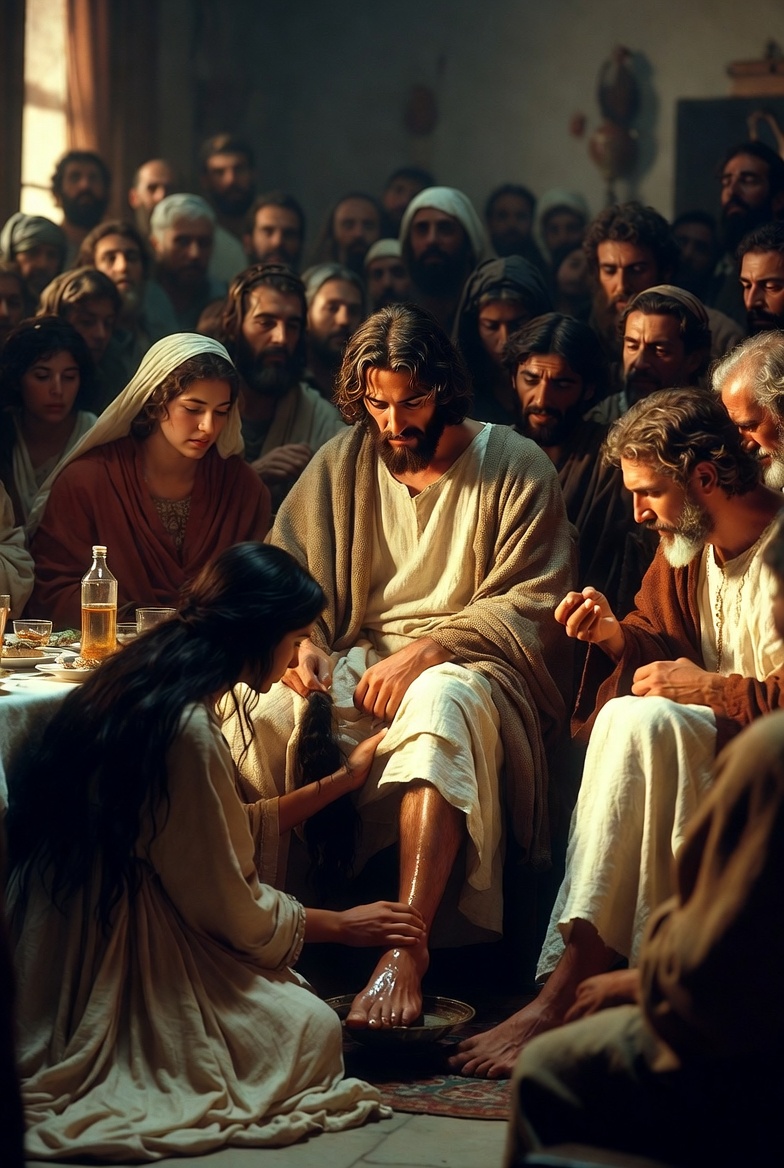
A Study of John 12:1-11
“Six days before the Passover, Jesus therefore came to Bethany, where Lazarus was, whom Jesus had raised from the dead. So they gave a dinner for him there. Martha served, and Lazarus was one of those reclining with him at table. Mary therefore took a pound of expensive ointment made from pure nard, and anointed the feet of Jesus and wiped his feet with her hair. The house was filled with the fragrance of the perfume. But Judas Iscariot, one of his disciples (he who was about to betray him), said, “Why was this ointment not sold for three hundred denarii and given to the poor?” He said this, not because he cared about the poor, but because he was a thief, and having charge of the moneybag he used to help himself to what was put into it. Jesus said, “Leave her alone, so that she may keep it for the day of my burial. For the poor you always have with you, but you do not always have me.” When the large crowd of the Jews learned that Jesus was there, they came, not only on account of him but also to see Lazarus, whom he had raised from the dead. So the chief priests made plans to put Lazarus to death as well, because on account of him many of the Jews were going away and believing in Jesus.”
John 12:1-11 ESV
Observation/Summary (short explanation of what the passage says in your own words):
Six days before the passover Jesus went to Bethany, the home of Lazarus who He had raised from the dead. While He was there, Lazarus’ family hosted a dinner for Jesus and His disciples where Martha served and Lazarus reclined at the table with Jesus. As they reclined around the table, Mary took a pound of expensive nard and anointed the feet of Jesus and wiped them with her hair. As she did so, the house was filled with the fragrance of the expensive perfume.
Then, Judas Iscariot, the disciple who was soon to betray Jesus said, “Why was this ointment not sold for three hundred denarii and given to the poor?”. But he didn’t say this because he cared about the poor. He said it because he was in charge of the money bag, and used to steal from it. Jesus then said, “Leave her alone, so that she may keep it for the day of my burial. For the poor you always have with you, but you do not always have me.”
Soon a large crowd found out where Jesus was and they came to see not only Him, but also Lazarus who Jesus had raised from the dead. Because of this the religious leaders plotted to put Lazarus to death too, because many of the Jewish people were believing in Jesus because of him.
Textual Analysis and Implication (what is being said and what does this mean?):
Chapter 12 begins with the time marker, “Six days before Passover…”. This means it was the last week before Jesus’ death, and almost half of the gospel of John is dedicated to the last week of Jesus’ life. At this time Jesus came to Bethany, which is less than two miles from Jerusalem, and was the home of Mary, Martha, and Lazarus who Jesus raised from the dead. John, the gospel writer, is careful to point out that Passover is soon to begin as a way of reminding the reader that Jesus, who raised Lazarus from the dead, is about to go to His own execution to be the ultimate sacrificial, Passover Lamb, to save His people from the their sin.
After the setup of verse one, in verse two we read that “they” gave a dinner for Jesus where Martha served and Lazarus reclined at the table with Jesus and the others. It is often assumed this dinner was given by Mary and Martha, but the text actually does not say; it merely says “they”. So, while Martha clearly helped to host the dinner, it is also possible that a number of families from the village of Bethany came together to host a dinner for their honored guest, Jesus, who had just raised Lazarus, a man from the village, from the dead. And this would hardly be surprising given the warm response and ensuing belief in Jesus that followed the recent resurrection.
As Jesus reclined at the table, Mary took a pound of expensive perfume/ointment made from pure nard and anointed Jesus feet with it and wiped His feet with her hair. As she did so, the house was filled with the fragrance of the perfume. This was an astonishingly large amount of very expensive oil, likely extracted from the root and spike of the nard plant which is grown in India. The purity of the oil and distant location it came from are why it cost so much.
In this culture people reclined at the table with their feet extending out away from it, and this is what made Jesus’ feet easily accessible. It was common to have a servant wash the feet of guests with water and a towel before a meal, but here Mary came and washed Jesus feet with expensive perfume and her hair as an expression of worship and devotion. Even though it was extremely rare for a woman to let down her hair in public in this time and place, Mary did not care what others might think, or what the cost of the perfume would be. To her, this was a mere pittance compared to the value and glory of Jesus.
In response to this act of loving worship by Mary, Judas, who was about to betray Jesus, said, “Why was this ointment not sold for three hundred denarii and given to the poor?”. While it is Judas Iscariot who spoke up, Mark 14:4 and Matthew 26:8 tell us many of the disciples and other people there wrongly felt the same indignation. So, while John did point out that Judas was about to betray Jesus, this outburst did not make anyone begin to think him capable of betrayal at the time. However, as John reflected on this incident, he was unable to do so without pointing out that Judas was about to betray the Savior.
Judas estimated the perfume could have been sold for 300 denarii. One denarius was a daily wage for a laborer, making this perfume bottle worth a year’s wages (Jewish laborers did not work on Sabbaths and other holy days). This was a large amount of money which tells us that either Mary’s family was very wealthy, or this was a family heirloom she had inherited. Whatever the case Judas expressed a sentiment that put practical care for the poor against adoration of Jesus. What makes this gift from Mary different from opulent displays wrongly done in the name of Christ today is that Mary gave this directly to Jesus. She did not use money that should have been spent on bread to build an extravagant building or something like that. She anointed the body of the Lord of Glory for burial before His crucifixion. This was a unique opportunity she had to express love and adoration for Jesus. While we don’t have the ability to do the same today, we can learn from Mary’s sacrificial gift in giving out of our own resources to spread the gospel and meet practical needs.
In verse six John adds that Judas did not say this because he cared about the poor, but because he was a thief, and as he was in charge of the moneybag, he used to steal from it. At the time however, John and the other disciples did not know this, but Jesus did. Even though Jesus knew Judas was a thief who would betray Him, He still called Judas to follow Him and let Judas be the group treasurer. Judas was the sort of person who hid his greed behind a mask of feigned charity. He did not care about the poor, he simply viewed the spilled perfume as a lost opportunity for more theft if it had been converted into money. The money Judas was in charge of was given by people who supported Jesus’ ministry, such as the wealthy women mentioned in Luke 8:2-3. And this money was used to meet the needs of the disciples as they travelled, and also for the benefit of various people in need, but Judas also regularly embezzled funds to enrich Himself.
The indignation of Judas sprang from discontent, greed and love of money. Discontent is the very sin which led to the fall of the Devil. And this evil seed in the heart of Judas eventually led him to betray the Lord of glory to crucifixion for thirty pieces of silver. Sin is a seed, and it will grow if it is not rooted out. We should take even “little” sins seriously. Judas was a human being just like any of us, and apart from the work of God’s Spirit in us, we are no less capable of the same murderous betrayal. Every journey, be it into darkness or light, begins with a single step. None of us will be perfect on this Earth, but as we follow Christ, He will continually work in our hearts to cleanse us of sin and make us grow in righteousness. When we do sin, we can rejoice to know that Jesus will always forgive us as we confess and repent, but let us be ever increasingly willing to confess and repent knowing our God is eager and willing to forgive.
In response to the words of Judas, Jesus said, “Leave her alone, so that she may keep it for the day of my burial. For the poor you always have with you, but you do not always have me.” There is no evidence that Mary or anyone else knew Jesus was about to die, so it is very unlikely Mary consciously anointed Jesus in preparation for His death and burial; this was simply a lavish act of love and devotion. But in the same way that Caiaphas said more than he knew in John 11:50 when he unwittingly prophesied that Jesus would die for the whole nation, Mary’s conscious act of loving worship also prefigured Jesus’ coming burial preparation by Joseph of Arimathea and Nicodemus (John 19:38-42), a fact that she and the others undoubtedly reflected on later.
Jesus’ remark that they would always have the poor with them to whom they could give alms, but not Him, is spoken with Divine foresight and authority because He knew He was soon to be killed. While John does not point it out, Mark 14:10-11 tells us it was after these words of Jesus that Judas finally spoke to the chief priests about betraying Jesus. This information makes it clear that Judas began his plot to betray Jesus before the last supper.
Next, verse 9 says that a large crowd of Jews learned where Jesus was and came to see not only Him, but also Lazarus who He had raised from the dead. Soon after He raised Lazarus from the dead, Jesus had left Bethany for a town called Ephraim (John 11:54) so, few people besides Lazarus’ family and the other mourners had seen Jesus since the resurrection. But now that Jesus was back in Bethany, and at a public dinner held in His honor, many people heard about it and came to see Him and Lazarus. As it was near the Passover festival and Bethany was very close to Jerusalem it is likely that not only people from Jerusalem came, but also other pilgrims who had travelled for Passover.
Because of this we read in verses 10-11 that Lazarus also became a target for the murderous plots of the chief priests, because on account of his resurrection, many Jews were coming to believe in Jesus. Not only did the chief priests reject Jesus as the Messiah, but many of them were also Sadducees, and the Sadducees did not believe in a resurrection. So, the raising of Lazarus provided added embarrassment for them as it defied their theological system. These men were only interested in propping up their little earthly power structure, and this drove them to the madness of defying Heaven itself.
In witnessing a miracle of resurrection, rather than believing in Jesus they decided to kill the man He had raised to life. Could they not see that Jesus would be able to raise Lazarus again even if they killed him a hundred times? Their hatred made them foolish and illogical. They were willing to go to murderous lengths to silence the testimony of Lazarus to the resurrection power of Jesus. And in them we see that when people hate Christ, they also hate those who love Christ and are blessed by Him.
Response (How does this change how I think, act and pray?):
From Mary we have an example of loving and adoring Christ no matter what other people might think. The Lord Jesus is to be valued above anyone or anything in this world. And from the reaction of Judas to Mary and the chief priests to Lazarus, we see that love for Jesus and testifying of His grace and power will be met with hatred and malice in this world. But still, no power of Hell or scheme of man will ever prevail against Jesus and His church. His kingdom is coming and is here now, advancing in the hearts of men and women around the world as they come to faith in Him despite derision and even violent persecution.
Jesus is our Savior and God who loves us so much He died on a cross to pay for our sin and give us eternal life. For the short time we have on this fallen Earth, we should now, out of love for Him, go boldly forward declaring His gospel and showing His love to the people around us.
Self Reflection:
- I don’t have a pound of expensive nard or the opportunity to wash Jesus’ feet with it, but what has the Lord given me in the form of material possessions or talents?
- How can I use what Jesus has given me to express my love and adoration for Him?
- Who can I show the love of Christ to, and where do I have opportunity to share the glorious truth of the gospel?
 Home
Home 
Leave a comment