
A Study of John 12:12-19
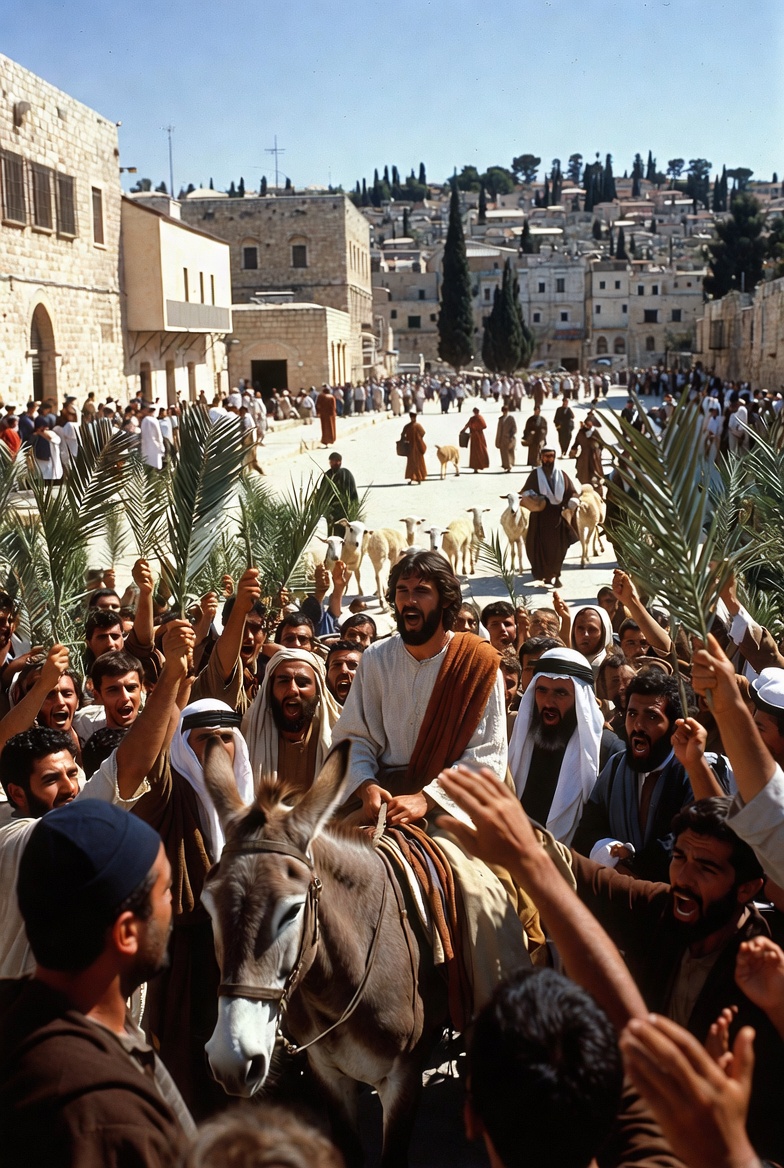
“The next day the large crowd that had come to the feast heard that Jesus was coming to Jerusalem. So they took branches of palm trees and went out to meet him, crying out, “Hosanna! Blessed is he who comes in the name of the Lord, even the King of Israel!” And Jesus found a young donkey and sat on it, just as it is written, “Fear not, daughter of Zion; behold, your king is coming, sitting on a donkey’s colt!” His disciples did not understand these things at first, but when Jesus was glorified, then they remembered that these things had been written about him and had been done to him. The crowd that had been with him when he called Lazarus out of the tomb and raised him from the dead continued to bear witness. The reason why the crowd went to meet him was that they heard he had done this sign. So the Pharisees said to one another, “You see that you are gaining nothing. Look, the world has gone after him.””
John 12:12-19 ESV
Observation/Summary (short explanation of what the passage says in your own words):
The day after the dinner held in Jesus honor in Bethany, a large crowd found out Jesus was coming to Jerusalem. So, they gathered palm branches and went out to meet Jesus saying, “Hosanna! Blessed is he who comes in the name of the Lord, even the King of Israel!”. At this time Jesus found a young donkey and sat on it, just as it was prophesied, “Fear not, daughter of Zion; behold, your king is coming, sitting on a donkey’s colt!”.
At the time, Jesus’ disciples did not understand all of this, but later when Jesus was glorified, they remembered these things had been prophesied about Him and had been done to Him. After this the crowd that was there when Jesus raised Lazarus from the dead continued to tell people about it, and the crowd who came to meet Him with palm branches did so because they had heard about this miracle. So the Pharisees said to each other, “You see that you are gaining nothing. Look, the world has gone after him.”
Textual Analysis and Implication (what is being said and what does this mean?):
Verse 12 tells us “the next day the large crowd that had come to the feast heard that Jesus was coming to Jerusalem.” This was probably the Sunday of passion week, the last week before Jesus’ death. The “great crowd” would have been made up of not only people from Jerusalem, but also many Jewish pilgrims from elsewhere who had travelled to Jerusalem to celebrate Passover, which John refers to as “the feast.” Passover was the most important Jewish holiday, and as people came to Jerusalem for it they brought lambs with them that would be sacrificed. So, as Jesus travelled from Bethany and the crowd swelled around Him, He, the Lamb of God, was likely surrounded by lambs, who were also on their way to be killed.
Next, we read that the crowd of people waved palm branches and shouted, “Hosanna! Blessed is he who comes in the name of the Lord, even the King of Israel!”. While palm branches are plentiful around Jerusalem, their use is not prescribed during Passover, but ever since the successful Maccabean revolt which drove out Syrian forces about two centuries earlier, palm branches had become a national symbol. This is because when Simon the Maccabee drove out the Syrians from Jerusalem, he was celebrated and greeted by the people with waving palm branches and music. This symbol of national pride also featured at the rededication of the temple and was used on coins minted by Jewish rebels during the ill-fated wars against Rome in AD 66-70 and 132-135. In this instance, the waving of palm branches by the people most likely revealed a nationalist hope that Jesus had come to drive out the Romans.
“Hosanna” means “give salvation now,” and it was a popular term of praise at the time. It also occurs in Psalm 118:25, and every Jew would have known this as Psalms 113-118 were sung by the temple choir every morning during the Feast of Tabernacles and every man and boy waved a palm branch when the choir reached the “Hosanna!” of Psalm 118:25. The words which come after, “Blessed is he who comes in the name of the Lord,” also come from Psalm 118, and while this phrase was used in regard to pilgrims travelling to Jerusalem, it could also be directed toward a Davidic king. The fact that the last words were, “even the King of Israel,” indicates the crowd intended this kingly meaning as they shouted them at Jesus.
This being the case, while this shows a recognition of Jesus as Messiah, it was not as the Messiah He came as, but as the Messiah the larger populace wanted Him to be, which was, a conquering political figure who would overthrow the Roman occupation. Jesus will return as a conquering king at the end of the age, but in His first coming He did not come to overthrow worldly political regimes. He came to die for our sin, and overthrow the kingdom of this world: sin, death and the Devil. Jesus was going to Jerusalem to bring about a salvation that far exceeded the worldly expectations of the shouting crowd.
John then tells us that Jesus found a young donkey and rode it, thus fulfilling the prophecy from Zechariah 9:9 which said, “Fear not, daughter of Zion; behold, your king is coming, sitting on a donkey’s colt!”. John does not go into the details here, but the other gospels provide more information about how Jesus arranged for the donkey to be brought to Him ahead of time. While the people hailed Jesus as a conqueror, He defied their expectations by riding on a donkey. A powerful warhorse would have communicated an intention to lead a military campaign against Rome, but the donkey, while it could be used by an important person, also signified Jesus’ peaceful intentions. His choice to use the donkey served to dampen the nationalistic fervor of the crowd.
While the bulk of the OT passage quoted in verse 15 is from Zechariah 9:9. The first words, “Fear not,” are not. The passage from Zechariah instead opens with, “Rejoice greatly,”. This is probably because John combined this quotation with Isaiah 40:9 where one who brings good news to Zion is addressed. The combination of two different OT passages in this way is common in the NT (Matthew 27:9-10 and Mark 1:2-3). The words “daughter of Zion” was a common way of referring to the people of Israel, particularly in reference to their state as the oppressed or fallen people of God. The quotation from Zechariah 9:9 bears even more weight when the following verses from Zechariah (9:10-11) are considered. In those verses God promises the coming of the gentle King will remove and break all instruments of war, proclaim peace to the nations, and that His rule will extend to the ends of the Earth. In them God also declares that He will “free your prisoners from the waterless pit.”
With these points borne in mind, John uses this passage to illustrate how Jesus arrived as a gentle King who could not be described as a nationalistic zealot, but instead came to proclaim peace to the nations and reign over all to the ends of the Earth. His reign will be worldwide, and the blood of His covenant means release for prisoners trapped in the bonds of sin and death.
However, verse 16 tells us at the time John and the other disciples did not understand these things, but later after Jesus was glorified they remembered these prophetic words had been written about Him and done to Him. This is similar to John 2:22 where John said the disciples did not understand what Jesus meant when He said if “this temple” was destroyed He would raise it again in three days, but then they did understand after Jesus rose from the dead that He had been talking about His body.
“Rose from the dead” and “glorified” mean virtually the same thing in these two passages. Jesus was glorified when He rose from the dead, and it is after His resurrection that He gave believers the Holy Spirit by which the disciples were enabled to look back and understand how Jesus had fulfilled prophecy. Comments like this from John help illustrate how the disciples’ initial lack of understanding and rudimentary thinking developed over time and were radically enhanced by the later coming of the Holy Spirit.
Verses 17-18 explain why such a large crowd gathered to meet Jesus in this way. It is because the people who witnessed Jesus raise Lazarus from the dead had continued to testify of what they saw, and many people heard about the miracle. Despite the efforts of the religious leaders to suppress information about Jesus that John mentioned in previous chapters, these people refused to be silent and persistently spread the word. Their faithfulness to bear witness to the glory of Jesus is an example all of us who follow Him should learn from.
Lastly for this passage, in response to this, the Pharisees said to each other, “You see that you are gaining nothing. Look, the world has gone after him.”. As this large crowd gathered, the potential for an uprising against Rome existed. While Jesus had no intention of leading such a revolt, the potential did not go unnoticed by the Pharisees and it only added to their opposition to Jesus. While the Pharisees did not love the Roman occupation, they still thought it was in their best interest to quietly endure it and they were increasingly agitated by the popularity of Jesus. By this point the Sanhedrin (the ruling Jewish council made up of Pharisees and Sadducees) had already decided to put Jesus to death, but because of the crowds they had to continue their plot in secret.
But as the crowds grew so did the political instability, and this explains the hyperbolic remark, “the world has gone after him.”. In this we see yet more Johannine irony. By the “world” the Pharisees meant all of Jerusalem, including those who had travelled from around the Mediterranean, but the “world” in the rest of the gospels commonly refers to every ethnicity across the entire globe; i.e. all of lost mankind which God sent His Son to save. It was in fact Jesus’ mission to save the world, and this crowd that greeted Him foreshadowed the larger world that will receive and still is receiving Him as Lord and Savior today.
Additionally, in the same way the attempts of the Pharisees to stifle Jesus’ popularity were total failures, so too have all the subsequent attempts throughout the past two millennia been total failures. Just as Jesus said, the gates of Hell will not prevail against the advance of His church. Despite even violent persecution, the kingdom of God continues to advance in the hearts of men and women around the globe. Truly, the whole world is going after Jesus.
Hallelujah, what a Savior.
Response (How does this change how I think, act and pray?):
In this passage we see yet another example of Jesus fulfilling prophecies written centuries earlier. In total, Jesus fulfilled over 300 hundred prophecies. This is further evidence that He is who He says He is; God incarnate. We are also reminded in this passage that Jesus raised Lazarus from the dead, He has the power of life, and death has no power over Him. Furthermore, just as Lazarus and his family had to endure the sorrow of his death and burial, we too will have to undergo hardships in this world, but we can persevere with joyful certainty that Jesus has overcome the world, and He will raise us to eternal glorious life with Him in His kingdom. He is our conquering king who has defeated sin and death.
We should also learn from the example of the witnesses to Jesus’ miraculous work in this passage. We who follow Him today have so much more reasons to tell others of Jesus. We not only know that Jesus raised Lazarus from the dead, but also that He died to pay for our sin and rose back to life Himself. Now, everyone who repents of their sin and trusts in Jesus as their God and Savior will be saved. The world truly is going after Jesus and it is a blessing to be used by Him in His mission to save people from all over the world before He returns one day to banish sin and death to the pit and make all things new.
Self Reflection:
- How does Jesus’ victory over death give me peace and hope in the midst of life’s struggles?
- How does Jesus’ fulfillment of hundreds of prophecies written centuries before His coming give me confidence in who He is?
- Who can I share the good news of the gospel with in my life?
 Home
Home 
Leave a comment