
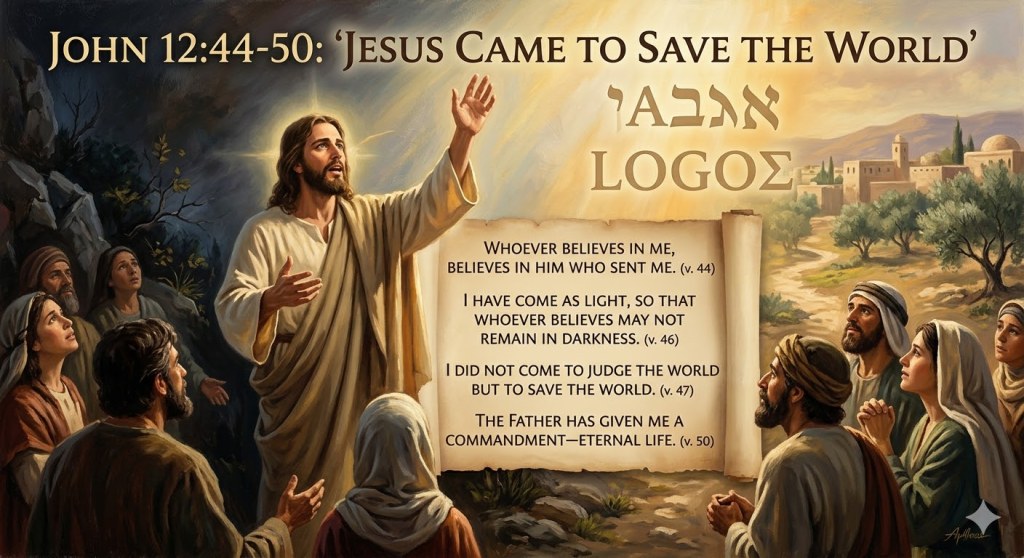
A Study of John 12:44-50
“And Jesus cried out and said, “Whoever believes in me, believes not in me but in him who sent me. And whoever sees me sees him who sent me. I have come into the world as light, so that whoever believes in me may not remain in darkness. If anyone hears my words and does not keep them, I do not judge him; for I did not come to judge the world but to save the world. The one who rejects me and does not receive my words has a judge; the word that I have spoken will judge him on the last day. For I have not spoken on my own authority, but the Father who sent me has himself given me a commandment—what to say and what to speak. And I know that his commandment is eternal life. What I say, therefore, I say as the Father has told me.””
John 12:44-50 ESV
Observation/Summary (short explanation of what the passage says in your own words):
Jesus said loudly that whoever believes in Him does not merely believe in Him, but in the One who sent Him, and that whoever sees Him, sees the One who sent Him. Jesus came into the world as light so that those who believe in Him will not stay in darkness. If anyone hears the words of Jesus and does not accept them, He does not judge them, because He did not come to judge the world but to save it. But the one who does not accept His words does have a judge; the very words Jesus has said will judge them on the last day. Jesus did not speak only in His own authority, but rather, in the authority of God the Father Who sent Him and commanded Him what to say. And importantly, the commandment of God the Father is eternal life. Therefore, everything Jesus said was exactly what the Father told Him to say.
Textual Analysis and Implication (what is being said and what does this mean?):
These last verses of John 12 are the final words John records Jesus as speaking to the public. What Jesus “cries out,” or in other words, shouts, in this final public teaching is a summation of all His teaching and a challenge to make a decision about what to believe. He begins in verses 44-45 saying, “Whoever believes in me, believes not in me but in him who sent me. And whoever sees me sees him who sent me.” Throughout His ministry Jesus repeatedly spoke about His unity with God the Father, and said that to believe in Him is to believe in the Father. In doing this Jesus made it clear that faith in Him is not merely faith in a mortal human or prophet, but rather, faith in God Himself. Jesus is fully human and fully God. He is the ultimate revelation of God, God incarnate, the eternally existent and all creating Word made flesh; the one and only, unique Son of God who is one with the Father. Therefore everything Jesus does and says is at one with the will of the Father, and to see and believe in Jesus is to see and believe in the Father who sent Him.
Then Jesus said, “I have come into the world as light, so that whoever believes in me may not remain in darkness.” As the Son of the Father, Jesus is the revelation, or revealer of God. As He said in John 8:12, “I am the light of the world.” Jesus came to a world languishing under the darkness of sin and the penalty of death as a light, full of grace and truth, to rescue us who live in darkness so that we need not “remain” in darkness. Mankind must believe in Jesus and follow Him or else live in gloomy darkness for eternity.
Next, Jesus said, “If anyone hears my words and does not keep them, I do not judge him; for I did not come to judge the world but to save the world. The one who rejects me and does not receive my words has a judge; the word that I have spoken will judge him on the last day.” Jesus already made it clear the ones who keep His word will know the truth and will not taste death (John 8:31-32, 52), and, through John the Baptist, that whoever does not believe in the Son of God remains under God’s wrath (John 3:36). This means Jesus did not come for the specific purpose of bringing condemnation, but rather, to save mankind from the condemnation we are already under (John 3:17-18), although judgment has also been given to Him to execute at another time (John 5:22). What we need to understand here is that the same gospel message that proclaims forgiveness of sin and life to those who believe in Jesus, also declares a sentence of righteous wrath and condemnation to those who reject Jesus, and importantly, this judgement is now close at hand.
Jesus did not need to be incarnate in human flesh if He only came to judge mankind. There would be no need to add humanity to His deity in order to do that. But He did need to become human to save humanity, and this is exactly what He did. For this reason, in this final public address, His words are not words of condemnation. They do contain a loving warning, but more than that they are a gentle, and loving appeal to turn to Him in faith and be saved. The theologian William Barclay describes this concept well by saying, “Always in the Fourth Gospel there is this essential paradox; Jesus came in love, yet his coming is a judgment.”
Finally for this chapter, Jesus explains why His words carry for the power of life for those who believe and pronounce judgement on those who do not, saying, “For I have not spoken on my own authority, but the Father who sent me has himself given me a commandment—what to say and what to speak. And I know that his commandment is eternal life. What I say, therefore, I say as the Father has told me.” The reason why Jesus’ (God the Son’s) words have this ultimate power is because His words are God the Father’s words. Everything Jesus says and does is in accordance with the command of the Father. In fact, Jesus is the Word incarnate that John spoke of in chapter one. In other words, Jesus is the eternally existent, all-powerful God who created all things incarnate in human flesh; God’s revelation of Himself to mankind. As such, God’s commands are behind everything Jesus says, and believing in what Jesus says leads to eternal life, but rejecting what Jesus says leads to condemnation, death and eternal suffering.
Jesus came to save the world, and John ends his depiction of Jesus’ public ministry on this note summing up the teaching and ministry of Jesus. Jesus, as God in the flesh, lived His life in perfect obedience to the will of the Father, and now He is about to die on a cross in perfect obedience to the Father, because He is the Word become flesh (John 1:14); the Lamb of God Who came to take away the sin of the world (John 1:29).
Response (How does this change how I think, act and pray?):
This passage tells us, yet again, that belief in Jesus is the one and only way to be saved from the penalty for our sin and for a restored relationship and eternal life with God. Importantly this tender call from Jesus to believe in Him also comes with a loving warning of judgment to come. Jesus came at first not to judge, but save us, because we are already condemned for our sin. But while the purpose of His first coming was not to judge, the very purpose He came for tells us that judgment will come for all who reject Jesus’ gracious gift of salvation.
Crucially, Jesus’ words on all these matters can be trusted. Jesus was not simply a human prophet or teacher. He is the Son of God in human flesh, meaning He is God incarnate as fully God and fully human, and every word He spoke and action He performed is perfectly aligned with the will of God the Father. He alone has the authority to forgive sin and grant eternal life, and He does this only for those who repent of sin and believe in Him as their Lord God and Savior. God is light, and Jesus lovingly came to us who are trapped in the darkness of sin and under the curse of death to save us from the eternal punishment our sin deserves.
All who accept His freely offered gift will be saved for a glorious eternity in a new Heaven and Earth as God’s children, but those who reject Jesus will be given what they want; an eternity separated from Him in gloomy darkness where there will only be weeping and gnashing of teeth. This hard truth is vitally important for us to know and share with others so they too can be saved.
Self Reflection:
- Have I believed in Jesus Christ as my Lord God and Savior? Why or why not? (Always be ready to give a reason for the hope that is in you.)
- How does the fact that Jesus left the matchless splendor of Heaven to suffer and die to save me, motivate me to follow His command to go to people and tell them about Him? (Following His example of lovingly coming to us, we must lovingly go to others.)
- Who can I be praying for in my life to trust Jesus as their Savior? Where are there potential opportunities for me to share the truth of the gospel?
 Home
Home 
Leave a comment