
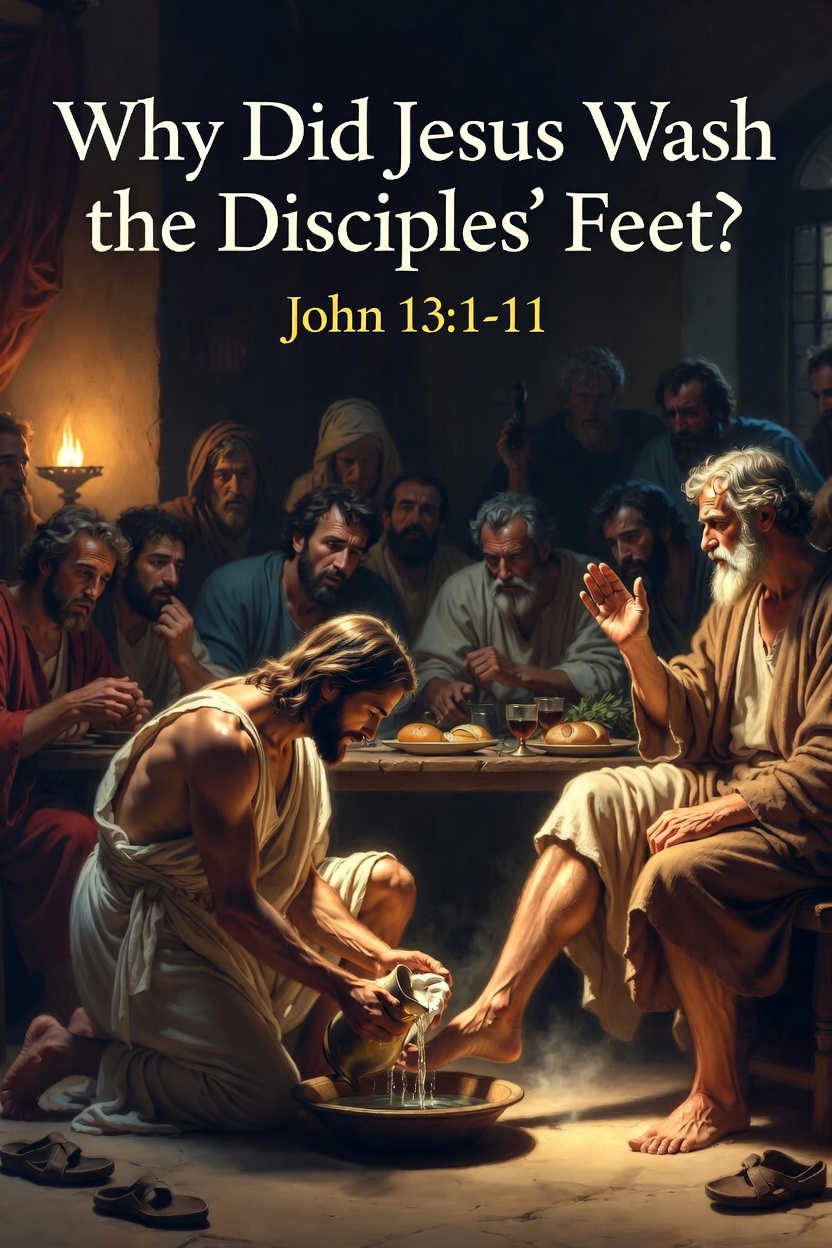
A Study of John 13:1-11
“Now before the Feast of the Passover, when Jesus knew that his hour had come to depart out of this world to the Father, having loved his own who were in the world, he loved them to the end. During supper, when the devil had already put it into the heart of Judas Iscariot, Simon’s son, to betray him, Jesus, knowing that the Father had given all things into his hands, and that he had come from God and was going back to God, rose from supper. He laid aside his outer garments, and taking a towel, tied it around his waist. Then he poured water into a basin and began to wash the disciples’ feet and to wipe them with the towel that was wrapped around him. He came to Simon Peter, who said to him, “Lord, do you wash my feet?” Jesus answered him, “What I am doing you do not understand now, but afterward you will understand.” Peter said to him, “You shall never wash my feet.” Jesus answered him, “If I do not wash you, you have no share with me.” Simon Peter said to him, “Lord, not my feet only but also my hands and my head!” Jesus said to him, “The one who has bathed does not need to wash, except for his feet, but is completely clean. And you are clean, but not every one of you.” For he knew who was to betray him; that was why he said, “Not all of you are clean.””
John 13:1-11 ESV
Observation/Summary (short explanation of what the passage says in your own words):
Before the Passover Feast, Jesus knew his hour to die and go to the Father had come, and He loved His own who were in the world to the very end. During supper, the devil had already put it into Judas Iscariot’s heart to betray Jesus. Jesus knew the Father had given all things into His hands, and that He had come from and was going back to God, and He got up from the table, took off His outer garments and tied a towel around His waist. Next, He poured water into a wash bowl and started to wash the disciples’ feet and wipe them with the towel.
When He got to Simon Peter, Peter said, “Lord, do you wash my feet?” and Jesus answered, “What I am doing you do not understand now, but afterward you will understand.” Then Peter said, “You shall never wash my feet.” to which Jesus replied, “If I do not wash you, you have no share with me.” So Simon Peter said to Him, “Lord, not my feet only but also my hands and my head!” Jesus said to him, “The one who has bathed does not need to wash, except for his feet, but is completely clean. And you are clean, but not every one of you.” Jesus knew who was going to betray Him; that is why He said, “Not all of you are clean.”
Textual Analysis and Implication (what is being said and what does this mean?):
Verse 1 tells us the following took place as Jesus shared a meal with His disciples before the Passover Feast. Scholars debate whether this meal took place on the actual day of Passover or if it was the Passover meal, but celebrated the day before Passover. The chronology is not entirely clear because some passages seem to indicate Jesus’ crucifixion took place on the day of Passover, but others make it seem like Jesus was crucified the day after Passover. There has been a lot of ink spilled in discussing this issue, and multiple solutions and explanations have been presented, but it is difficult to say which explanation is correct. However, the main things are clear, that is, what Jesus said and did in His final hours, and then of course the event of His death and resurrection. While matters of precise chronology can be interesting and worth looking into, we should also make sure to focus most on what matters most; Jesus’ life, death and resurrection.
What is clear is that whether or not this meal took place on the actual day of Passover, Jesus and His disciples treated it as a Passover meal. And this calls the reader’s attention to the Passover theme John has developed throughout the entirety of his gospel account (John 2:13, 23; 6:4; 11:55; 12:1) and calls the reader to understand the following footwashing by Jesus to point towards His ultimate redemptive Passover act on the cross as the Lamb of God who takes away the sin of the world (John 1:29).
John also writes in verse 1 that Jesus knew “his hour had come.” Throughout John’s gospel Jesus frequently communicated His hour to die, decided by the Father, had “not yet come,”. But recently, in John 12, as some Gentile Greeks sought Jesus, Jesus indicated the climatic hour was near, and now He knows the time for Him to leave this “world” and return to the Father has come. The use of the term “world” is significant. In John’s gospel the term “world” is used frequently to differentiate between Jesus’ disciples and the rest of lost, unbelieving humanity (the world). The followers of Jesus must live among the world until the time comes for us to go home to our Father in Heaven, just as Jesus did.
But crucially, God loves the world (John 3:16), and sent His only and unique Son, Jesus, to save the world and bring men and women out of it into His kingdom. For this reason, we who follow Jesus are not immediately removed from the world upon receiving salvation, but instead, like Jesus, we dwell here for a time to be used in God’s loving rescue mission to save our fellow, fallen humans. And we and all the others who are saved out of this world through faith in Jesus become part of a new entity; upon receiving salvation we are no longer part of the “world”, we are Jesus’ “own” disciples who He loves. While God loves the whole world, the object spoken of as Jesus “own” in this verse, and in the following chapters, refers not to the whole world, but instead specifically to this entity separate from the world composed of Jesus “own” followers; i.e. the people of God.
This is who John writes of at the end of verse 1 where he says Jesus, “having loved his own who were in the world, he loved them to the end.” Another possible wording instead of “to the end”, is “to the full extent of his love.” This means Jesus not only loved them to the end of His life, but also to the fullest extent possible, and ultimately it communicates that Jesus showed His faithful, perfect love for His own in His sacrificial death on the cross. “Greater love has no one than this, that someone lay down his life for his friends.” (John 15:13)
After this preamble, in verse 2 we read, “During supper, when the devil had already put it into the heart of Judas Iscariot, Simon’s son, to betray him,”. In the original Greek manuscripts of this passage it is not entirely clear whose “heart” is spoken of here. Is it the heart of Judas or the heart of the devil? This in no way brings Judas’ own responsibility into question though, because it is the heart that wills what Satan wills that is in turn inspired by Satan to act as a willing participant in his evil plots. The question does remain though, did John say the devil had put it “into his own heart” that Judas would betray Jesus, or that the devil had put the idea to betray Jesus into “the heart of Judas”? While the question is an interesting one, the lack of a clear answer does not at all obscure the main point of the verse. What is clear is that the devil and Judas at this point are both willing conspirators in a plot to betray Jesus unto suffering and death.
Continuing on, in verses 3-5, John says Jesus, knowing the Father had given all things into His hands and that He was going back to God, rose from supper, laid aside His outer garments and wrapped a towel around his waist before pouring water into a basin and then washed the disciples feet with the water and the towel. Jesus’ knowledge of the will of the Father mentioned in verse 1 is restated here, but with two important additions. Jesus knew not only that the time for Him to leave the world had come, but also that 1) the Father had given all things into His hands, and 2) that He had come from God. “Put all things into His hands” means Jesus had power over all things, and “come from God” communicates Jesus’ Divine identity.
With this sort of status and power most of us would guess that next Jesus would defeat the devil in some kind of ostentatious display of power, and that He would unmask Judas as a traitor with a bolt of lightning from Heaven. But Jesus did none of these things. Instead He quietly washed the disciples’ feet, including the feet of Judas the traitor. The washing of feet in this time and place was especially necessary because everyone wore sandals and therefore had rather dirty feet after walking around all day. While it was customary to have one’s feet washed before a meal, this task was done only by the lowliest servants, and peers would almost never wash each other’s feet except in rare moments of a grand expression of love. In fact the task was viewed as so lowly there were some Jews who argued that Jewish slaves should not be ordered to wash feet, but only non-Jewish slaves, women, children or lowly students.
With this being the case, while the disciples likely would have been willing to wash Jesus’ feet, they did not want to wash each other’s feet, so no one had volunteered to do so before they commenced this meal. With an understanding of the culture around footwashing at the time, their lack of desire to wash each other’s feet is understandable, but it was also heightened by the fact that they viewed each other somewhat as competitors for places of honor in Jesus’ kingdom as we learn from Luke 22:24 that as the disciples came to this room for the meal they were debating over who was the greatest. But here Jesus tossed aside the cultural norm, yet again turning things upside down from a worldly perspective, and showed them what true greatness is by donning the garb of a lowly servant and humbly washing their dusty feet, and in doing so, simultaneously showed His love for them, displayed a symbol of salvific cleansing and provided all believers with an example of loving, humble conduct to follow.
The scene looked like this: The disciples would have been reclining on thin mats on the ground around a low table. Each one would be leaning forward on their side on a cushion with their feet pointing outward. As they reclined this way Jesus rose from His mat, removed His outer garments, wrapped Himself in a towel, like the lowliest servant in that culture, and then began to wash their dirty feet. In doing this Jesus lived out His claim from Luke 22:27 where He said, “I am among you as one who serves.” It is likely Peter had this image still emblazoned in his mind decades later when he wrote in 1 Peter 5:5 that Christians are to be, “submissive to one another, and be clothed with humility.” In the original Greek Peter literally wrote “wrap the apron of humility around yourself.”
Jesus, the Creator of Heaven and Earth, the Most High God, came down to the most low point of washing the feet of those who would abandon Him and scatter when He was arrested. More than that, He descended from the matchless splendor of Heaven, obeying the Father’s will, to die on a cross and be buried in a tomb. In doing this God revealed Himself and His glory most ultimately in humble weakness and service. True to His own teaching Jesus showed that, “The greatest among you must be your servant.” (Matthew 23:11)
As Jesus came to Simon Peter, Peter said, “Lord, do you wash my feet?”, and Jesus responded, “What I am doing you do not understand now, but afterward you will understand.” All of the disciples present were undoubtedly uncomfortable about what happened as their Master stooped to wash their feet. But while most of them were stunned into silence, Peter of course had to speak up. While Peter’s objection here, as with his other objection (Mark 8:32-33), is well intentioned, it displays an ignorance of Jesus’ mission. Peter was incredulous that Jesus would wash his feet, but Jesus tells him he must accept this foot washing, that he does not understand now, in faith.
In this Peter voiced what the other disciples thought too. They could not understand why the One they followed as the Messiah would do such a thing, because they did not yet understand the symbolism of this humble act. But just as Jesus promised, they would come to understand later after Jesus’ death and exaltation. This footwashing pointed forward to the terrible and glorious sacrificial death of Jesus on the cross to pay for the sin of the world.
Next, Peter said, “You shall never wash my feet.” to which Jesus replied, “If I do not wash you, you have no share with me.” Then Peter said, “Lord, not my feet only but also my hands and my head!”. After Jesus had just told Peter he wouldn’t understand what He was doing now, rather than trusting Jesus, Peter leaned into his lack of understanding with this objection. Peter was only thinking at the worldly level of what was culturally acceptable and did not comprehend the symbolism of what Jesus was doing. But Jesus spoke to this symbolism by saying he (Peter) would have no part with Him (Jesus) if he did not let Jesus wash his feet. And this is true for everyone. Anyone who does not accept Jesus’ offer to cleanse them of their sin cannot have their sin taken away, and therefore have no part with Jesus. The idea of having a “part” of something is often used in the Bible in regard to inheritance and also refers to eschatological blessing. It is not entirely clear how Peter understood this in this moment, but it is clear he understood it meant being linked to Jesus and he greatly desired this.
What is pretty clear is that neither Peter nor any of the other disciples grasped the meaning of the footwashing as foreshadowing the coming barbarity of the cross Jesus would endure to pay for the sin of the world. What Peter did comprehend of Jesus’ words though was enough to elicit a typically exuberant response from him, “not just my feet but my hands and my head as well!”. In one sense Peter exhibited humility by recognizing Jesus’ greatness when he objected to Jesus washing his feet, but in another sense Peter demonstrated a lack of humility when he did not trust Jesus was in the right and objected to the foot washing. Furthermore, while we shouldn’t be too harsh about Peter’s exuberant response to have his hands and head washed too, we should recognise that he was once again demonstrating a lack of humility in trying to take control of the situation. Jesus is the Lord, not us, and true humility submits to Him in all things down to the last detail, especially those we struggle to comprehend.
After Peter’s misguided response Jesus said, “The one who has bathed does not need to wash, except for his feet, but is completely clean. And you are clean, but not every one of you.” And then John the gospel writer adds, “For he knew who was to betray him; that was why he said, ‘Not all of you are clean.’.” Physical washing is used as a picture of spiritual washing throughout the Bible, and here Jesus teaches that there is a difference between an initial cleansing when we come to faith in Him and an ongoing washing as we continue on with Him in faith. When we first come to believe in Jesus we receive our initial, vital washing away of our sin by trusting Him and what He accomplished for us on the cross. At this first moment of salvation our sin is washed away for all time, but still, as we continue to live in this world in bodies under the curse of sin we will stumble and sin, and so in another sense we need a continual “foot washing”. This describes acknowledging our sin and confessing it to our Lord in prayer, and continuing to trust in His finished work on the cross to pay for our sin.
Importantly, it is not that we must painstakingly create an itemized list of every stumble we make in order to be forgiven, but we must live with the awareness that we are still sinners and will struggle against sin until the day we die and pass on from this Earth. We are saved once and for all by grace, and we need to live by grace each day. Thankfully, although we still do sin, just as John also wrote in 1 John 1:8-9, “If we say we have no sin, we deceive ourselves, and the truth is not in us. If we confess our sins, he is faithful and just to forgive us our sins and to cleanse us from all unrighteousness.” So, just as a person who has bathed is clean, they may still require a smaller foot washing after a short walk on a dusty road. Once we come to Christ, we must continually come to Him each day, eagerly pursuing Him with our whole heart.
Finally, what is also notable about this passage is that Jesus clearly also washed the feet of Judas Iscariot, the one who He knew was going to betray Him. In addition to showing the humility of Jesus, and His love even for His avowed enemies, this also makes it clear that no physical rite, even one performed by Jesus, saves a person from their sin. Judas’ feet were washed, but he was not cleansed. The other place where Jesus told His disciples they were clean is in John 15:3 where He said, “You are already clean because of the word I have spoken to you.” This means true spiritual cleansing comes through trust in Jesus’ revealed word and atoning sacrifice on the cross; the sacrifice to which this foot washing pointed.
Response (How does this change how I think, act and pray?):
Jesus knew Who He was, what lay ahead of Him, and where He was going afterwards, but with the full knowledge of His divine origin and authority, He humbly showed His love for His followers in washing their feet and providing this object lesson that they would understand only after His crucifixion/exaltation. As He contemplated the coming horror of the cross, His focus was still on demonstrating His love for His disciples. And He did not demonstrate His love with some kind of ostentatious display, but rather, by donning the garb of the lowliest servant and performing one of the lowliest tasks one could perform in that culture. While He is the all-powerful, all-creating, and uncreated God of the universe, He is also humble, gentle and meek. He even washed the feet of Judas Isariot who He knew would betray Him shortly after.
Importantly our response to Jesus’ humble offer to cleanse us, must be a humble acknowledgment of our need to be washed by Him and a humble acceptance of His offer to do so. This means admitting we are sinners in need of salvation and believing that Jesus’ redemptive work on the cross has paid the penalty for our sin. Jesus Christ our Lord and God Who died for us and rose again is the only One Who can and will save us from sin and give us eternal life. But we must trust in Him as our Lord God and Savior. No physical rites or good deeds can save us. Judas Iscariot had his feet washed by Jesus but he was not cleansed of his sin because he did not believe in and submit to Jesus as Lord.
Self Reflection:
- What does Jesus’ decision to humbly wash His disciples’ feet as He considered the coming horror of the cross tell me about His love for me?
- What are some practical ways I can follow His example and extend this same selfless love to the people around me?
- What does Jesus’ choice to wash even Judas Iscariot’s feet tell me about how I should respond to people who hate me?
 Home
Home 
Leave a comment