
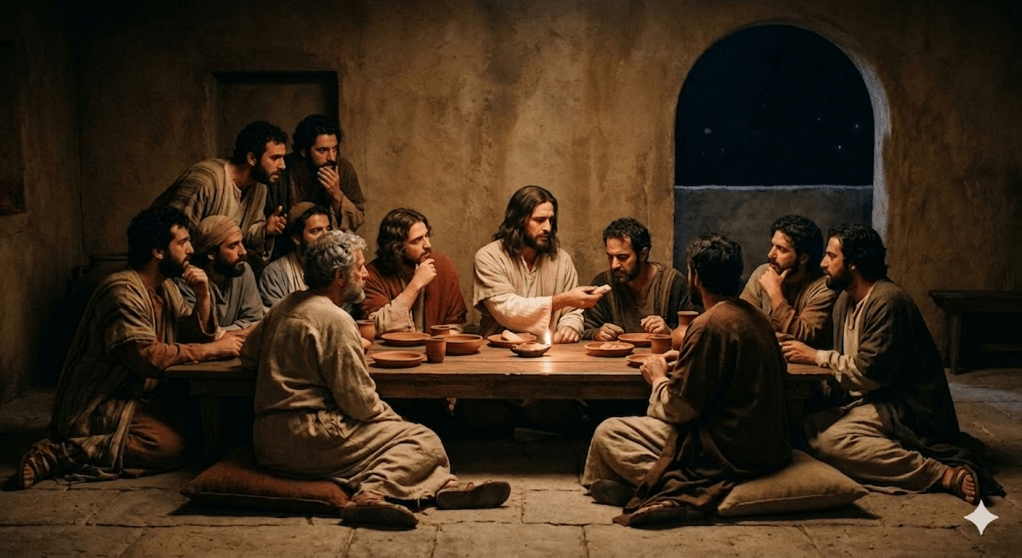
A Study of John 13:21-30
“After saying these things, Jesus was troubled in his spirit, and testified, “Truly, truly, I say to you, one of you will betray me.” The disciples looked at one another, uncertain of whom he spoke. One of his disciples, whom Jesus loved, was reclining at table at Jesus’ side, so Simon Peter motioned to him to ask Jesus of whom he was speaking. So that disciple, leaning back against Jesus, said to him, “Lord, who is it?” Jesus answered, “It is he to whom I will give this morsel of bread when I have dipped it.” So when he had dipped the morsel, he gave it to Judas, the son of Simon Iscariot. Then after he had taken the morsel, Satan entered into him. Jesus said to him, “What you are going to do, do quickly.” Now no one at the table knew why he said this to him. Some thought that, because Judas had the moneybag, Jesus was telling him, “Buy what we need for the feast,” or that he should give something to the poor. So, after receiving the morsel of bread, he immediately went out. And it was night.”
John 13:21-30 ESV
Observation/Summary (short explanation of what the passage says in your own words):
After washing the disciples’ feet, and explaining to them that He had just provided an example to follow, Jesus was troubled in His Spirit and said to them, “Truly, truly, I say to you, one of you will betray me.” The disciples looked around at each other, and they did not know who Jesus was talking about. A disciple who Jesus loved (John the gospel writer) was reclining next to Jesus, and Simon Peter gestured to him to ask Jesus who He was talking about. So, John asked Jesus who it was, and Jesus said, “It is he to whom I will give this morsel of bread when I have dipped it.” Jesus then dipped the bread and gave it to Judas the son of Simon Iscariot. After taking the bread from Jesus, Satan entered into Judas, and Jesus said, “What you are going to do, do quickly.”
None of the other disciples knew why Jesus said this to Judas. Some of them thought He was telling Judas to buy what they needed for the feast, and others thought maybe He told Judas to go and give money to the poor, since Judas was in charge of the moneybag. After taking the bread from Jesus, Judas immediately left; all this happened at night.
Textual Analysis and Implication (what is being said and what does this mean?):
In the previous verses Jesus washed the disciples’ feet and then explained to them that in doing so He had provided them with an example of loving, humble service to others that they needed to follow. In the middle of this He also quoted from Psalm 41 saying, “He who ate my bread has lifted his heel against me.” as a way of obliquely saying He knew He would be betrayed soon.
After this, in verses 21-22, we read that Jesus was troubled in His spirit and said to them much more directly, “Truly, truly, I say to you, one of you will betray me.” The disciples then looked at each other and they did not know who Jesus was talking about. Until now, Jesus had only referred to a future betrayal in indirect terms, but now He spoke of it plainly. The twelve disciples had already been perplexed by Jesus’ references to His future suffering and death because they thought of Him as the Messiah Who would usher in His kingdom at that very moment. They had no concept of a Messiah Who would suffer for the sin of the people. Hearing about the coming betrayal now would also have been confusing for them. They may have wondered, if Jesus could cast out demons, walk on water, calm storms, heal the sick and raise the dead, what calamity could possibly befall Him that He could not deal with?
However, Jesus was “troubled in His spirit” over the impending betrayal by Judas. This means He was deeply grieved and upset about it. Jesus was not emotionally unaffected about the coming cross and the events surrounding it. He loved Judas and was upset for Judas’ sake as much as His own. The word translated as “testified” is “martyreo” in the original Greek and it is used to describe someone bearing witness to certain facts. In this case Jesus bears witness to the world’s evil, specifically the evil treachery of one of His close followers as He says, “One of you will betray me.” In the awkward and likely embarrassing silence that followed this statement, the disciples looked around at one another at a total loss for who Jesus was speaking of. None of them suspected Judas or any other disciple present. In this somber moment Judas was confronted with a choice, he could either turn back from his treacherous plot and ask for forgiveness, or forge ahead in his planned betrayal of Jesus.
Next, in verse 23 John the gospel writer adds, “One of his disciples, whom Jesus loved, was reclining at table at Jesus’ side,”. This is the first time the “disciple whom Jesus loved” appears in this gospel, and he will make several more appearances later (John 19:26-27, 20:2-9, 21:1, 20-25). This disciple is often referred to as the “beloved disciple” by commentators and the textual evidence overwhelmingly suggests this is John the son of Zebedee; the gospel writer and one of the original 12 disciples present at this meal with Jesus. John does not give himself this anonymous title out of arrogance or anything like that, but more as a way of communicating the magnificent grace and love of Jesus for him; the same love Jesus has for all of His followers.
John’s decision not to directly reveal his identity here and elsewhere is also in order to avoid giving even the barest hint of sharing the spotlight with Jesus. Similar to John the Baptist who said of Jesus “He must increase, but I must decrease.”, John the gospel writer is merely a witness providing a testimony to the world about Jesus the Son of God. In this John provides an example for other followers of Jesus to copy; being Jesus’ disciple means having a loving relationship with Him wherein we live for His glory and not our own.
Lastly for verse 23, we should note that it was the custom in this time and place to sit on the ground at a low table at most meals, but the custom of reclining, which was introduced by the Greeks, was reserved for special occasions. Therefore, eating in this way was basically a cultural requirement at a Passover meal. This is one more piece of evidence that shows Jesus and His disciples were eating the Passover meal this evening.
Because this beloved disciple was reclining next to Jesus, verses 24-25 say, “so Simon Peter motioned to him to ask Jesus of whom he was speaking. So that disciple, leaning back against Jesus, said to him, ‘Lord, who is it?’.” Jesus’ announcement that one of the 12 would betray Him undoubtedly produced a stunned silence at the table, but unsurprisingly, Peter was the first to break the silence. Peter may have wanted to know who the traitor was so he could try to stop them. However, even he was not bold enough to voice his question himself, so he motioned to John, who was reclining next to Jesus, to quietly ask who Jesus was talking about.
In the western world, many would be put off by the closeness of two men exhibited here by Jesus and John. But in many other parts of the world, particularly the Near East, it is common for men to walk down the street holding hands as a sign of friendship; there is absolutely no homosexual connotations associated whatsoever with this kind of contact. Notably, these same cultures would balk at the proximity of men and women in public in our Western culture; for a man and woman to hold hands in public would be considered licentious. So, for any from a Western background who might wonder at this, all this is to say, the close proximity of John and Jesus is a normal and acceptable sign of friendship in their culture. And reclining next to Jesus in this way, John the beloved disciple discreetly asked Jesus Peter’s question.
Jesus answered, “‘It is he to whom I will give this morsel of bread when I have dipped it.’ So when he had dipped the morsel, he gave it to Judas, the son of Simon Iscariot.” It seems like Jesus answered John quietly as verses 27-30 show the other disciples had no idea why Judas left after this. There is a question though as to why John, the disciple who Jesus loved, did nothing. Perhaps he was simply too stunned to move, or because Jesus calmly did nothing, he followed His example. As to Jesus dipping a morsel and giving it to Judas, Jesus was filling the role of host at this feast. The host of a feast in this culture may have dipped into the common bowl and pulled out an especially sumptuous bit and given it to a guest as a sign of friendship or honor. The word translated from the Greek as “morsel” often referred to bread, but could also refer to meat. The fact that Jesus was easily able to pass it to Judas indicates Judas was close, maybe even on the left hand side of Jesus which was considered the place of honor.
Most of all, Jesus’ giving of this morsel to Judas was a sign of love. For many of us we may sometimes think someone is against us, rightly or wrongly, and this can cause us to treat them with suspicion or unpleasantness. In this case Jesus knew for certain Judas would betray Him, but He humbly washed Judas’ feet and then lovingly honored him with this passing of a choice morsel at the feast. He showed divine love to Judas and gave him one last chance to repent and abandon his traitorous plot without revealing him to the other disciples. In this we see an example of what it means to love one’s enemies, and to bless those who curse you.
Despite this last loving gesture from Jesus, Judas did not repent and we read in verse 27, “Then after he had taken the morsel, Satan entered into him. Jesus said to him, “What you are going to do, do quickly.”.” Judas took the morsel Jesus offered him, but he refused to accept Jesus’ love. Instead he hardened his heart against Jesus, thus making a final surrender to the darkness, and the darkness consumed him as Satan entered him. Satan could not have entered Judas if Judas had not opened himself up to Satan. Judas could have repented and accepted Jesus’ loving power to withstand the attack of the devil, but he was resolved to betray Jesus and became a willing tool of Satan.
Seeing Judas wholly given over to evil, Jesus told him to hurry up and get his act of treachery over with. Jesus knew Judas had passed the point of no return and would not respond to any further appeals of love. Judas thought he was the master now and that he would do away with Jesus. So, Jesus sent him on his way; the sooner this wicked delusion ran its course, the better.
Next, verses 28-29 tell us, “Now no one at the table knew why he said this to him. Some thought that, because Judas had the moneybag, Jesus was telling him, “Buy what we need for the feast,” or that he should give something to the poor.” None of the disciples knew why Jesus sent Judas away. If they had known, they would have prevented him from betraying Jesus. They simply thought Judas was sent to pay expenses for the feast or to give money to the poor. This detail about paying expenses or giving to the poor has led some to believe this must have been the night before the actual night of the Passover, because they question whether shops would be open on the night of Passover. But if this were the case there would be no need for Jesus to send Judas out to buy for a feast still 24 hours away. There would have been plenty of time the next day.
However, it is most likely this was the actual night of Passover. The “Feast” the disciples (wrongly) thought Judas was sent out to buy supplies for would be the Feast of Unleavened Bread which began that same night and went on for seven days. Because the next day was a Sabbath, it may have seemed better to make purchases that evening instead. While less convenient, it would have been possible to buy things that night. Rabbinic authorities were not in agreement on this issue, but people were allowed to buy necessary items on Sabbath if something was left in trust rather than paying cash.
Also, as far as the possibility of giving alms goes, it was a common custom to give alms to the poor on Passover night as the gates of the temple were left open from midnight onwards which meant beggars could gather there. If this were any night other than Passover, the disciples would probably not have assumed Judas was going to give alms. Notably, while Jesus and the disciples lived on charitable donations, they still set aside a portion of that to give charitably themselves. However, as we know, Judas was not going out to do either of these things. He was hastening to betray the Lord of glory for silver.
Lastly for this section of chapter 13, after Jesus gave Judas the morsel of bread and told him to do what he was going to do, “he immediately went out. And it was night.” Although Judas was now possessed by Satan, he still had to obey the words of Jesus. I think John shared this detail to make it yet clearer that no one can take Jesus’ life from Him. He laid it down willingly. Despite the humble love Jesus showed Judas in the course of the dinner, Judas still chose to betray Him and went out into the dark night, leaving Jesus, the Light (John 1:4), behind. Even though Judas had the best example and Teacher possible, he still gave himself over to evil. We, as fallen humans, need more than a good example; we need a Savior. Jesus is the Savior we need, but He does not force us to accept Him. Judas made his choice, and so must we all.
While Jesus would also go into the dark night leading to His crucifixion, He, the Light, would not be overcome by the darkness (John 1:5). He would descend into the depths of the grave itself, and rise again victorious.
Response (How does this change how I think, act and pray?):
In this passage we learn more about the heart of Jesus. He was hurt and deeply troubled by the betrayal of Judas who was one of His close friends and disciples. However, Jesus did not prevent Judas’ betrayal, because it was allowed to happen as part of His loving and selfless plan to die for the sin of the world. And even though He knew Judas would betray Him, Jesus still showed humble, tender love to Judas until the very end as He washed Judas’ feet and honored him by offering a choice morsel at the last meal they shared together.
We also learn of Jesus’ total power and sovereignty in the small detail given where He finally told Judas to go and do what he was determined to do. The treachery of Judas did not take Jesus by surprise and Jesus could have stopped it if He wanted to. But He didn’t stop Judas because He, our loving God, was determined to give His life to save ours. But again, importantly, no one took Jesus’ life from Him; He willingly laid it down. Judas, along with Satan, were not in control in this dark moment. As they slithered off into the night to betray Jesus, they did so at His command.
Self Reflection:
- How does the humble love Jesus showed to Judas give me an example to follow in loving my enemies?
- What does Jesus’ determination not to stop Judas’ betrayal tell me about His love for me?
- If Jesus was willing to suffer this way to save me, how does this help me to trust Him in the midst of suffering I face in this life?


Leave a comment