
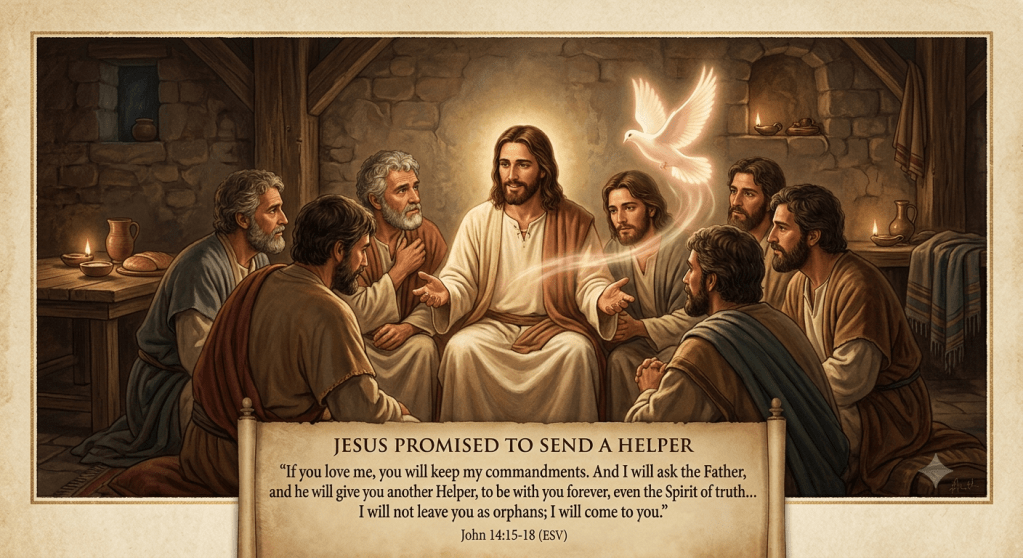
A Study of John 14:15-24
“If you love me, you will keep my commandments. And I will ask the Father, and he will give you another Helper, to be with you forever, even the Spirit of truth, whom the world cannot receive, because it neither sees him nor knows him. You know him, for he dwells with you and will be in you. I will not leave you as orphans; I will come to you. Yet a little while and the world will see me no more, but you will see me. Because I live, you also will live. In that day you will know that I am in my Father, and you in me, and I in you. Whoever has my commandments and keeps them, he it is who loves me. And he who loves me will be loved by my Father, and I will love him and manifest myself to him.” Judas (not Iscariot) said to him, “Lord, how is it that you will manifest yourself to us, and not to the world?” Jesus answered him, “If anyone loves me, he will keep my word, and my Father will love him, and we will come to him and make our home with him. Whoever does not love me does not keep my words. And the word that you hear is not mine but the Father’s who sent me.”
John 14:15-24 ESV
Observation/Summary (short explanation of what the passage says in your own words):
Jesus told His disciples if they love Him they will keep His commands, and also that He would ask the Father to send a Helper, and the Father would send Him. The Helper will be with Jesus’ followers forever, and this Helper is the Spirit of truth who the world cannot have because the world does not know or see Him. But Jesus’ followers know Him, because He dwells with them and is in them.
Jesus also promised not to leave His disciples as orphans, but to come to them. Soon the world would no longer see Him, but His followers will, and because Jesus lives, so will His disciples. In that day they will know that Jesus is in the Father, they are in Jesus, and Jesus is in them. Also, whoever has Jesus’ commands and obeys them is the one who loves Him. And those who love Jesus, are also loved by the Father, and Jesus loves them and will show Himself to them.
Then Judas (not Iscariot) said to Jesus, “Lord, how is it that you will manifest yourself to us, and not to the world?”. And Jesus told him if anyone loves Him (Jesus), they will keep His word, and the Father will love them, and “We” will come to them and make “Our” home with them. Those who do not love Jesus do not keep His words, and the words heard from Jesus are not merely His own but the Father’s Who sent Him.
Textual Analysis and Implication (what is being said and what does this mean?):
Previously, Jesus showed His humble, selfless love by washing the disciples’ feet, and then He told them to love one another in the same way He loves them. Also, in the verses just prior, Jesus promised the disciples would receive power from Him to do even “greater things” than He did, and said He would do whatever they asked in His name. Now, in verse 15, Jesus tells them how to love Him by saying, “If you love me, keep my commandments.” Obedience and a desire for God’s glory go hand in hand with asking for things in Jesus’ name and especially in loving Him. It is not possible to love God and care nothing for His commands.
Love for Jesus does involve sentiment and passion, but sentiment and passion for God without obedience is hollow and insincere. And while the fear of God is the beginning of wisdom, and we should have a reverential fear and awe for God, ultimately our obedience to Him, though imperfect, is to be motivated most of all by love for Him. Importantly, love for God does not require us to enter a convent/monastery or wear sackcloth and ashes. Love for God simply means living in the world where He has placed us and following His commands, which will in turn enable us to love those around us and shine the light of Jesus in our communities.
Thankfully Jesus has not left us on our own to try and obey Him, as He went on to say in verse 16, “And I will ask the Father, and he will give you another Helper, to be with you forever,”. The disciples at this time would have been fearful because Jesus just told them He would be leaving them soon, but He also assured them they would not have less help, but more help because He would ask the Father to send them another Helper. In other words, God the Son promised to ask God the Father to send God the Holy Spirit to every believer. And God the Holy Spirit does dwell within every believer to help us keep His commandments.
The term translated as “Helper” in the ESV is “parakletos” in the original Greek. The NIV renders this term as “Counselor”, and other versions translate it as “Comforter.” This word carries the idea of someone who comes alongside another to help, strengthen, advise and act or speak in their defence. The same term is also used by John in 1 John 2:1 to describe Jesus as our “Advocate” in the court of Heaven. Importantly this in no way describes the Holy Spirit or Jesus as being subordinate or lesser in any way. This describes one of the ways in which our loving God cares for us. It is also worth pointing out Jesus said “another” Helper. This implies that during His earthly ministry Jesus fulfilled this role for the disciples on Earth, but now the Holy Spirit does so. And lastly for this verse, this Helper, God the Holy Spirit, will be with us “forever.” God has come to dwell with all of us who believe in Him, and He will never leave us.
Continuing on, in verse 17, Jesus identified Who the Helper is saying, “even the Spirit of truth, whom the world cannot receive, because it neither sees him nor knows him. You know him, for he dwells with you and will be in you.” In John’s gospel this title refers to the Holy Spirit Who has been mentioned in earlier chapters (John 1:32-33, 3:5-8, 4:23-24, 6:63, 7:37-39). A primary reason why the Helper is called the Spirit of truth is because He declares the truth (John 16:12-15). In John 14:6, Jesus just proclaimed Himself to be the “truth”, so one way to define the Spirit of truth is as the One Who witnesses to the truth that Jesus is.
Jesus also said the “world” cannot receive the Helper, because it neither sees Him nor knows Him. The “world” in John’s gospel refers to the moral order of this world that is in rebellion against God. Even when confronted with Jesus, the Truth, in the flesh the world could not accept or believe Him, and being unable to accept Jesus Who it could see, the world certainly cannot receive the Spirit of truth Who it cannot see. If the world could receive the Truth it would no longer be the “world,” but rather, the kingdom of God. Only those who have come to believe in Jesus (which is itself a miraculous act of and gift from God) can receive the Spirit of truth. However, the Spirit of truth does still have work to do in regard to the unbelieving world which will be discussed in John 16:7-11.
Importantly, the disciples had already come to know the Spirit of truth better than they thought because they knew Jesus, but after His death and resurrection, they would come to know Him far more intimately. Once Jesus was exalted back to the Father in Heaven, He sent the Spirit of truth to dwell in them and in every believer. It is important for us who follow Jesus today to recognize this fact. We have the Spirit of truth, God Himself, dwelling within us. We have a close, personal relationship with our loving Creator.
Next, in verses 18-20, Jesus went on to say, “I will not leave you as orphans; I will come to you. Yet a little while and the world will see me no more, but you will see me. Because I live, you also will live. In that day you will know that I am in my Father, and you in me, and I in you.” At this point the disciples were likely still wrestling with feelings of abandonment after having been told Jesus would soon leave them. So, Jesus assured them He would not leave them as orphans, i.e. as children with no parents to care for them, but rather, He would come to them. The question must be asked though, which coming was Jesus referring to?
Was He referring to His resurrection, the coming of the Holy Spirit after the resurrection, or His second coming at the end of the age? While Jesus will come in all three of these ways, it may be most reasonable to assume He is referring to His return to the disciples after His resurrection. It is when Jesus rises from the dead and returns to the disciples that they come to understand more fully that He is in the Father and the Father is in Him. And the result of Jesus’ rising from the dead and “coming” to the disciples will be new life for them imparted to them by the Holy Spirit (Christ in them). So, the coming of the Spirit is a result of the “coming” Jesus is referring to, which is His return to the disciples after rising from the dead. However, there are of course different viewpoints on this, but the main thing is that Jesus did not disappear when He died; He rose again, reappeared to His followers bodily, came to dwell in them by His Spirit, and will return again one day at the end of this age.
In verse 21, Jesus then concluded this thought by saying, “Whoever has my commandments and keeps them, he it is who loves me. And he who loves me will be loved by my Father, and I will love him and manifest myself to him.” To “have” Jesus’ commandments does not simply mean to possess or know them. This phrase in the original Greek means “to grasp with the mind.” In other words it means to make Jesus’ commandments your own or to take them into your inner being. Here, again, Jesus makes it clear that to truly love Him will result in living according to His commands. None of us obey Him perfectly, but as we follow Jesus we are to care a great deal about His commands because of our love for Him and believing loyalty to Him. And when we do stumble, He is always willing and eager to forgive us.
Jesus also explained that because He and the Father are one, the person who loves Him will also be loved by the Father, and Jesus would love them too. Importantly, Jesus is not saying that it is because of our obedience to Him that He and the Father love us. God has the initiative in all things and therefore Jesus loves us before we ever come to hear His commands and obey. The point being explained here is that obedience and growth in obedience is a result of an ongoing relationship with Jesus (God).
And importantly, Jesus also said He would “manifest” Himself to the one who loves and obeys Him. In other words, Jesus shows Himself to those who love Him. The Greek verb translated here as “manifest” is used elsewhere to refer to the resurrection appearances (Matthew 27:53, Mark 16:9, Acts 10:40) and Jesus appearing in His resurrected body (John 20-21). In the Septuagint (The Greek translation of the OT) it is used to refer to theophanies (appearances of God). In other parts of the NT it refers to both the first coming of Jesus (2 Timothy 1:10) and His second coming (2 Thessalonians 2:8, 1 Timothy 6:14, 2 Timothy 4:1, Titus 2:3), as well as Jesus’ appearance in God the Father’s presence after His resurrection (Hebrews 9:24). With this wide range of the verb’s use in mind, from the context in which it is used in this passage Jesus is likely talking about His post resurrection appearance to the disciples, and also His continued manifestation to His followers up until this very day both by His Spirit and at other times in visions and other ways as He sees fit for each individual.
Next, in verse 22, “Judas (not Iscariot) said to him, ‘Lord, how is it that you will manifest yourself to us, and not to the world?’.” Although John had already written in previous verses that Judas Iscariot already left to betray Jesus, he makes it abundantly clear that this Judas in verse 22 is a different Judas with the parenthetical “(not Iscariot)”. This is likely the Judas referred to as “Judas of James” in Luke 6:16 and Acts 1:13. At this point the disciples did not have a clear understanding of the resurrection to come, nor did they understand exactly what Jesus meant by the sending of the Holy Spirit. So, Judas’ question is simply an honest inquiry as to how Jesus plans to reveal Himself to His disciples but not to the unbelieving world.
In verse 23, Jesus began to answer Judas saying, “If anyone loves me, he will keep my word, and my Father will love him, and we will come to him and make our home with him.” While Jesus affirms elsewhere that He will appear at the end of the age in a final apocalyptic sense, here He reiterates what He said in the previous verses to explain that at the moment He is speaking of His appearance that takes place within the context of the loving relationship He has with those who love and obey Him. Those who truly love Jesus, endeavor to obey His commands, and Jesus and the Father love them and make their home with them. And crucially, believers are not left to try and obey Jesus in their own strength. It is the third Person of the Trinity, God the Holy Spirit, Who dwells within us and helps us obey. And when we stumble and sin, this same Holy Spirit, convicts us of our sin, leads us in repentance, and assures of His grace and forgiveness.
Therefore, at the same time Jesus leaves His followers to prepare dwelling places in Heaven (John 14:2) He and the Father also come to dwell in the believer. This is what it means for followers of Jesus to have the Holy Spirit dwell within them. From the very first moment of salvation, God the Holy Spirit comes to dwell within us, and just as Jesus and the Father are one, the Holy Spirit is one with Jesus and the Father. This indwelling of the believer is a glorious foretaste of what will come in fullness at the end of the age when John’s words from Revelation will be fulfilled, “Now the dwelling of God is with men, he will live with them. They will be his people, and God himself will be with them and be their God… I did not see a temple in the city, because the Lord God Almighty and the Lamb are its temple” (Revelation 21:3, 22).
Lastly for this section of John 14, in verse 24 Jesus said, “Whoever does not love me does not keep my words. And the word that you hear is not mine but the Father’s who sent me.” With this Jesus once again stated both His equality with the Father and His submission to Him. And importantly, He also emphasized that love for Him and obedience to Him go hand in hand. Obedience to Him does not result in love for or from Him, but rather, it is love for and from Him that generates obedience. Jesus was also careful to once again state that His words which we are to obey are the words of the Father Who sent Him.
Response (How does this change how I think, act and pray?):
We learn from this passage that after Jesus’ resurrection and ascent back to Heaven He has not left us who follow Him alone as orphans. His return to Heaven initiated the giving of new life and His presence to all believers through the indwelling Holy Spirit. God the Holy Spirit is the “Helper” Jesus promised to send and all who believe in Jesus receive the Holy Spirit immediately upon receiving salvation through faith in Christ. It is also important for us to recognize that true love for Jesus should cause us to care about His commands and obey them. The words of Jesus are the words of the Father because Jesus and the Father are one. To love and obey Jesus is to love and obey the Father. And all who love and obey Jesus are loved by the Father too. Thankfully we are not left to try and obey Jesus in our own strength. The Holy Spirit, God Himself, is our Helper Who helps grow in obedience to His commands, proclaim the truth of Who Jesus is, and comforts and sustains us through the difficulties of life in a fallen world. And crucially, no matter what happens, He will never leave us or forsake us.
Self Reflection:
- Have I come to understand that love for Jesus means I will care a great deal about His commands?
- Doesn’t Jesus’ love for me mean His commands are for my own good and His glory?
- Have I made a habit of regularly appealing to God in prayer to help me obey His commands by the power of His Spirit in me?


Leave a comment