
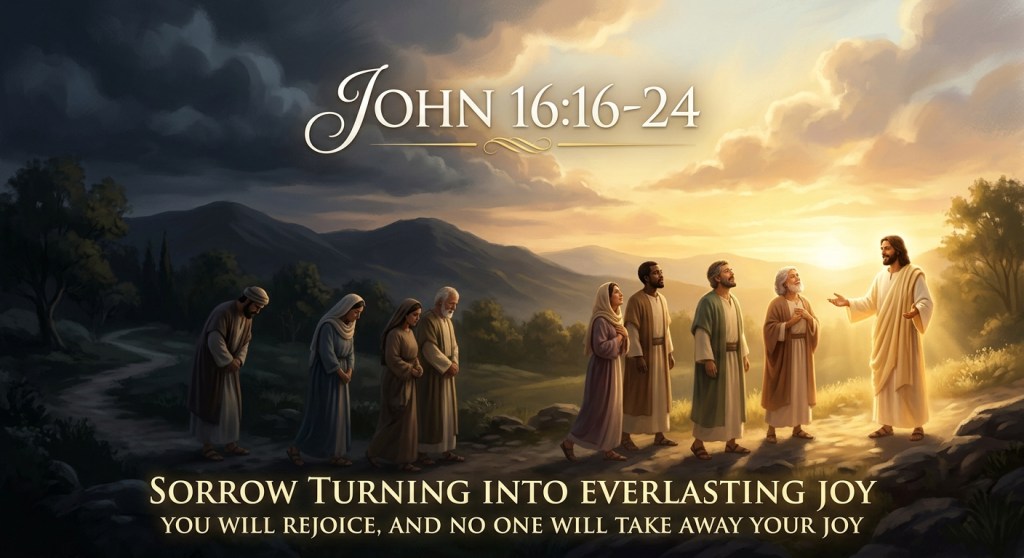
A Study of John 16:16-24
“A little while, and you will see me no longer; and again a little while, and you will see me.” So some of his disciples said to one another, “What is this that he says to us, ‘A little while, and you will not see me, and again a little while, and you will see me’; and, ‘because I am going to the Father’?” So they were saying, “What does he mean by ‘a little while’? We do not know what he is talking about.” Jesus knew that they wanted to ask him, so he said to them, “Is this what you are asking yourselves, what I meant by saying, ‘A little while and you will not see me, and again a little while and you will see me’?
Truly, truly, I say to you, you will weep and lament, but the world will rejoice. You will be sorrowful, but your sorrow will turn into joy. When a woman is giving birth, she has sorrow because her hour has come, but when she has delivered the baby, she no longer remembers the anguish, for joy that a human being has been born into the world. So also you have sorrow now, but I will see you again, and your hearts will rejoice, and no one will take your joy from you. In that day you will ask nothing of me. Truly, truly, I say to you, whatever you ask of the Father in my name, he will give it to you. Until now you have asked nothing in my name. Ask, and you will receive, that your joy may be full.”
John 16:16-24 ESV
Observation/Summary (short explanation of what the passage says in your own words):
Jesus told the disciples in a little while they would not see Him anymore, and then a little while after that they would see Him. The disciples then asked each other what Jesus meant by this, and also what He meant by “because I am going to the Father.” They did not know what Jesus was talking about. Jesus knew they wanted to ask Him so He asked if they were asking themselves what He meant by, “A little while and you will not see me, and again a little while and you will see me.”
Jesus told them soon they would weep and lament, but the world would rejoice. They would be sorrowful, but their sorrow would turn into joy. Just as when a woman is giving birth she has sorrow and pain, but then this turns into joy when her child is born, so too would their sorrow and pain turn into joy and no one would be able to take this joy from them. When that day came they would ask nothing of Jesus. Jesus also said whatever they asked the Father in His name would be given to them. Until this time they had not asked in Jesus’ name, but now He told them to ask and they would receive so that their “joy may be full.”
Textual Analysis and Implication (what is being said and what does this mean?):
After an explanation of the work the Helper, God the Holy Spirit, will do among them after He returns to the Father, in verse 16 Jesus said, “A little while, and you will see me no longer; and again a little while, and you will see me.” This statement provides a transition from Jesus’ explanation of the work of the Helper to the confusion of the disciples in vs. 17-18, which then sets up an explanation of Jesus’ departure and what will happen. But this raises the question, “Which departure and return is Jesus referring to?”. Some have thought maybe He is speaking of His return at the end of age, but in a study of the verses that follow we will see it is most reasonable to conclude Jesus was speaking only of His impending crucifixion and return to the disciples directly after His resurrection at this point. The disciples did not know it, but in only a few hours Jesus would be arrested, crucified and buried in a tomb. But they would see Him again a few days later when He appeared to them after rising from the dead.
Following this statement, in verses 17-19 we read, “So some of his disciples said to one another, “What is this that he says to us, ‘A little while, and you will not see me, and again a little while, and you will see me’; and, ‘because I am going to the Father’?” So they were saying, “What does he mean by ‘a little while’? We do not know what he is talking about.” Jesus knew that they wanted to ask him, so he said to them, “Is this what you are asking yourselves, what I meant by saying, ‘A little while and you will not see me, and again a little while and you will see me’?”.
The disciples were confused and more than a little distressed by this information. They still did not understand that the Messiah must first suffer and die before rising again and establishing His kingdom. And if He is going to establish His kingdom, they are also unable to understand why He would leave and send another “Helper” or “Counsellor” (Jn. 14:16) in His place. Their consternation confirms the words Jesus said earlier in verse 12, “I still have many things to say to you, but you cannot bear them now.” This information is already more than they can bear. In hearing this there is a break in the discourse as they ask questions between themselves about what Jesus could possibly mean about going away, going to the Father and “in a little while”. Jesus fully perceived and understood their confusion so He repeated their question and prepared to respond to it.
In verse 20, Jesus warned them about the coming sorrow saying, “Truly, truly, I say to you, you will weep and lament, but the world will rejoice. You will be sorrowful, but your sorrow will turn into joy.” This statement refers to the sorrow the disciples would experience over Jesus’ death that would turn into joy after His resurrection. While the world, i.e. the moral order in rebellion against God, would rejoice over killing Jesus, the disciples of Jesus would be in deep grief, but this grief would not last. While there will be a more complete, ecstatic joy followers of Jesus experience at His ultimate return at the end of this age, there is also a joy that characterizes us now because Jesus is risen from the grave and in Him we have life, joy and peace even as we continue to live in this fallen world for a short time. Speaking of this verse Charles Spurgeon pointed out that while the distress of these original disciples was great in the moment, looking back in their later writings they never spoke of Jesus’ death with regret. After the resurrection and Pentecost they wrote and spoke of the cross with joy for what Jesus accomplished there.
In verse 21 Jesus uses the image of childbirth to illustrate His point saying, “When a woman is giving birth, she has sorrow because her hour has come, but when she has delivered the baby, she no longer remembers the anguish, for joy that a human being has been born into the world.” Just as a woman experiences sorrow as she endures the intensity of labor pains, but this sorrow then turns into joy when her child is born, so too will the intense sorrow of the disciples during Jesus’ arrest and death turn into joy when they see Him resurrected. This imagery of childbirth is used a number of times in the Old Testament to describe the intense trial God’s people must endure before the joyful triumph of messianic salvation comes (Is. 21:2–3; 26:16–21; 66:7–14; Je. 13:21; Mi. 4:9–10), and in this instance at the cross, the Messiah Himself will undergo the greatest anguish “for the joy set before him” (Hebrews 12:2).
While Jesus will experience the far greater anguish, He is more concerned with the sorrow of His followers and follows up this non-narrative parable of childbirth to encourage the disciples in verse 22 saying, “So also you have sorrow now, but I will see you again, and your hearts will rejoice, and no one will take your joy from you.” The disciples will weep and lament, but after the resurrection they will rejoice, and no one will be able to take this joy from them. With the resurrection of Jesus comes the beginning of a new age and the coming of the Helper, the Holy Spirit. These followers of Jesus, and many still to this day are enabled by the Holy Spirit in them to endure all manner of persecution for the name of Jesus, and while they have sorrow for the night, joy comes in the morning and no one can take this joy from them. Whether we experience the fiery trials of persecution or affliction we have blessed hope and joy in Jesus that is a sure and steady anchor for our souls.
Interestingly, although the disciples will see Jesus again, Jesus chooses to say “I will see you again.”, emphasizing His seeing them. This speaks to the fact that when we come to know God, we find that it is God Who has first come to know us (Galatians 4:9). While we are held accountable for our choice to accept or reject Jesus, He is preeminent in all things and we cannot come to Him unless He first comes to us; we cannot see Him unless He first sees us. This statement of Jesus echoes His words from John 15:16, “You did not choose me, but I chose you…”.
Next, in verse 23, Jesus said, “In that day you will ask nothing of me. Truly, truly, I say to you, whatever you ask of the Father in my name, he will give it to you.” The phrase “In that day” or others like it in the New Testament usually refer to the end of the age. In this case it is not that Jesus is excluding the time period after His resurrection when the disciples see Him, but rather, He is including it. In other words, Jesus is referring to the entire period of time after His resurrection until His triumphant return as the end of the age. To confirm John the gospel writer’s thinking on this language see also 1 John 2:18 , “…this is the last hour.”
In saying they would ask nothing of Him in that day it seems Jesus is referring to their recent questions for more information. In that day, after Jesus’ resurrection and the coming of the Holy Spirit, their desire for information would be met. Everyone has a desire to know about the future, and as followers of Jesus, while we have yet to learn of many specific details, we know the important broad themes our Lord has revealed to us. Christ Jesus has risen, He has prepared a place for us with Him in Heaven, and He will return to Earth again. Evil will not have the final say. Our Lord is working now to save many more people and one day He will bring a final end to sin, suffering and death forever. There will be a new heaven and a new earth and all who have believed in Him will dwell in this perfect new creation in redeemed bodies that never wither or decay.
Also, and importantly, Jesus Christ is the ultimate Mediator between God and man. In Jesus we all have direct access to God the Father and make our requests in Jesus’ name, and the Father will hear and answer us. While we may ask for specific things and not get them, we can rest in the knowledge that God cares for us, and He knows what is best. And by the Holy Spirit in us, we will be given joy, peace and hope to endure faithfully amid sorrow and uncertainty with the joyful certainty that Jesus can, has and will do all He has promised. He Who died to save us will not abandon us now. He will return, and whether we die first or live to see that day, He will take us home with Him to Heaven to live in overflowing joy and pleasure forever.
Lastly for this section of John 16, Jesus followed up His statement about asking the Father in His name in verse 24 saying, “Until now you have asked nothing in my name. Ask, and you will receive, that your joy may be full.” Up to this point the disciples had asked for many things, but they had not asked the Father. Access to the Father through Jesus is a new privilege given to believers in this new age that dawned with the death and exaltation of Jesus. Under this new order these disciples, and all followers of Jesus, are told, “Ask, and you will receive.” And we are to do so with the knowledge that this is the way to the full and lasting joy Jesus promised earlier.
Prior to this statement Jesus explained joy in Him goes hand in hand with obedience (Jn. 15:11), abiding in Him (Jn. 15:4), in His love (Jn. 15:9), and in His word (Jn. 8:31). From all of this the bearing of fruit that remains will come (the spiritual fruit of godly living and faithful witness that leads more people to faith), and this fruit will come about as a result of prayer (Jn. 15:7-8). In this we see this shorter statement that asking and receiving from the Father leads to complete joy is a summary of the themes discussed by Jesus earlier, primarily in chapter 15, but which are now specifically set within the context of the new age following His death and resurrection.
Response (How does this change how I think, act and pray?):
In this passage we see Jesus’ selfless love and care for the disciples. Even as Jesus knew He was about to be arrested and crucified, He was concerned with preparing His followers for the coming sorrow and assured them this sorrow would turn into joy. As we follow Him today we carry this same joy of the resurrection and salvation in Jesus to steady us amid the sorrow and suffering we experience in this fallen world. As we endure trials of various kinds, by the power of the Holy Spirit in us, we are enabled to face them with the joyful certainty that because Jesus has risen and we have new life in Him, not even death itself can take our joy from us. We will pass through the thin veil of death into glorious eternal life in the presence of our loving Savior.
As we carry on in this world we should recall to mind the glorious access to God granted to us in Jesus. In Him we now have direct access to the Father and as we ask for things in Jesus name God will answer us for our good and His glory. We lack God’s perfect wisdom and knowledge, so sometimes we will ask for things that are good and seem best to us, but God will not answer in the way we want because He knows what we don’t know. But we can ask with the confidence that He will answer us in accordance with His good and perfect will, and His plan will result in the greatest of good and in full and lasting joy. He is worthy of our trust in all circumstances and at all times. He Who did not withhold His only Son from us is not holding out on us now.
Self Reflection:
- What are some practical ways I can make a habit of focusing on the reasons I have for eternal joy in Jesus as I endure the temporary hardships of this world?
- Have I set aside a daily time of focused prayer to make my requests to God, and also to praise Him and give thanks?
- What does this passage tell me about the selfless love of Jesus as I see that He was very concerned with encouraging and comforting His disciples even as He knew He was about to go to the cross?


Leave a Reply